IELTS Writing is scored across four criteria — and most students never get a breakdown of where they lost points. Here's how LingoForge grades your writing the same way examiners do, with specific feedback on every essay to help you improve.
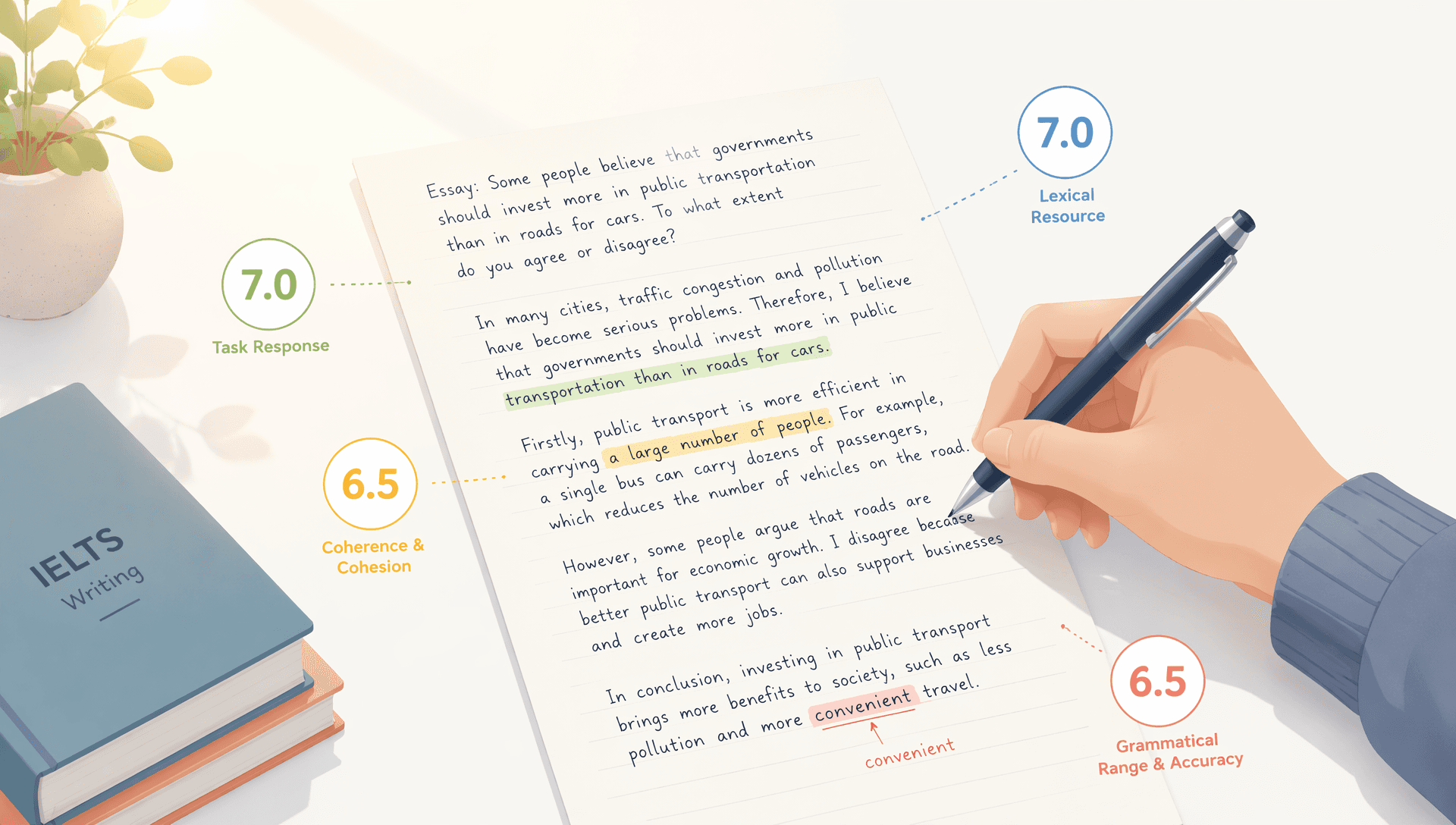
If you've ever gotten an IELTS Writing score that left you scratching your head — "Why did I get a 6.0 when my essay looked fine?" — you're not alone. IELTS Writing is graded against four detailed criteria, each scored independently on a 0–9 band scale. A strong vocabulary won't save you if your paragraphing is unclear. A well-structured essay can still score low if your grammar errors are frequent and repetitive.
The bigger problem for most test-takers? You never get told why. You write an essay, submit it, and receive a single number. There's no breakdown, no explanation, no roadmap for what to fix next.
That's the gap we set out to close with LingoForge.
Every IELTS Writing response — whether Task 1 (Academic or General Training) or Task 2 — is assessed across four areas, each worth the same weight:
Did you actually answer the question? For Task 1 Academic, that means identifying the key features of the chart or diagram and giving a clear overview with supporting data. For Task 2, it means presenting a clear position, developing your ideas with relevant support, and addressing every part of the prompt.
Common mistakes here:
Describing every detail in a chart without giving an overview
Stating an opinion but not developing it beyond surface-level points
Only addressing one side of a two-part question
Writing under the word count — this triggers automatic penalties
How well do your ideas flow? Is your essay logically organised? Do your linking words (however, nevertheless, in contrast) feel natural — or do they sound plugged in? Is your paragraphing clear and purposeful?
The jump from Band 6 to Band 7 here often comes down to naturalness. A Band 6 writer uses linking words correctly but a bit mechanically. A Band 7 writer uses them with more ease and flexibility.
This is about your vocabulary — but not in the way most people think. It's not about using "fancy" words. It's about precision. Can you say exactly what you mean? Do you use a range of words naturally, or do you repeat the same ones? Are your word choices accurate?
A Band 5 writer relies on simple, repetitive vocabulary. A Band 7 writer shows awareness of style and word combinations, with only minor slips.
This measures both the variety of sentence structures you use and how accurately you use them. A Band 5 writer attempts complex sentences but they tend to go wrong, relying on simple sentences for accuracy. A Band 7 writer handles a variety of complex structures with confidence, and most sentences are error-free.
Here's something important: examiners don't count every single mistake. They look for patterns. Occasional slips won't hurt much, but making the same grammar error over and over will pull your score down.
When you submit an IELTS Writing response on LingoForge, it gets evaluated against the full official band descriptors — the same ones examiners use. Here's what you get back:
You receive a band score (0–9) for all four criteria, along with a short explanation for each one. So instead of just seeing "6.0 overall," you might see that your Task Response is at 7.0 but your Grammatical Range is at 5.5 — and now you know exactly where to focus.
The official IELTS rules are strict about word count, and we apply the same rules:
20 words or fewer: Band 1 across the board
Significantly under the minimum (Task 1 under 100 words, Task 2 under 150 words): Task Achievement/Response is capped at Band 4
Somewhat under the minimum (Task 1 under 150 words, Task 2 under 250 words): Task Achievement/Response is capped at Band 5
So even a well-written 120-word Task 1 response will be capped at Band 5 for Task Achievement — because that's what happens in the real exam too.
We calculate your overall band slightly differently from a simple average. At least 3 of the 4 criteria need to reach a band for your overall to land there. If only 2 criteria hit Band 7 and the other 2 are at 6.5, your overall will be 6.5 — not 7.0.
Why do this? Because we'd rather you aim for a higher standard in practice. If you can consistently hit Band 7 on LingoForge, you're well-prepared for exam day — even with the natural variation that comes with human grading.
Beyond the scores, you get inline highlights on your essay — usually 5 to 12 of them. Each highlight shows you:
What was good and why it helped your score
What needs work and what specifically is wrong
A suggested rewrite so you can see a better version side by side
This means you're not just told "improve your grammar." You're shown the exact sentence with the issue, what the issue is, and how to fix it.
Most students don't know which criterion is their weakest. You might be strong in vocabulary but stuck in grammar. Our four-criterion breakdown makes this visible right away, so you can stop wasting time on things you're already good at.
Generic advice like "use more complex sentences" doesn't help much. Our feedback points to your exact words and explains the specific issue — whether it's a subject-verb agreement slip, an awkward transition, or a word that doesn't quite fit. And each suggestion comes with a rewrite, so you can see the improvement in context.
Every graded response is saved to your account. You can look back at past essays, compare scores, and spot trends. If your Coherence & Cohesion has been sitting at Band 6 for five essays in a row, that's a clear sign it's time to study paragraphing and linking words.
Because our overall score is tougher than the real exam, hitting your target band on LingoForge means you're likely to match or beat it on test day. It takes the guesswork out of "am I really at a 7.0?"
If English isn't your first language, you can choose to receive feedback in Chinese, Japanese, Korean, Thai, or Vietnamese. This makes the explanations easier to understand and act on — especially when you're still building your English confidence.
Here's an example of what you might receive after submitting a Task 2 essay:
Overall Band: 6.5
Task Response: 7.0 — "Your position is clear and well-developed. Main ideas are extended with relevant examples, though some supporting arguments could be more precise."
Coherence & Cohesion: 6.5 — "Ideas are generally well-arranged with clear progression. Some linking words feel mechanical, and paragraphing could be more logically structured."
Lexical Resource: 6.5 — "Vocabulary is adequate and generally appropriate. You attempt some less common words but with occasional mismatches in word combinations."
Grammatical Range & Accuracy: 6.5 — "A mix of simple and complex structures is used. Errors occur but rarely get in the way of meaning. Try varying how you open your sentences."
Summary: A short overall assessment noting what you did well, what to work on, and a reminder that real exam grading has some natural variation.
Suggestions: Four or more specific, practical tips based on your essay.
Inline Highlights: 5–12 spots in your essay marked as good, needs improvement, or error — each with an explanation and suggested rewrite.
The difference between Band 6 and Band 7 isn't about writing more. It's about writing more precisely — with clearer organisation, more natural grammar, and more accurate vocabulary. LingoForge gives you the kind of detailed, practical feedback that most students never get, along with concrete examples of how to improve.
Stop guessing why you scored the way you did. Start getting real answers.

Learn the top 5 IELTS Writing Task 2 templates for band 7+. 70% of test takers using templates achieve higher scores. Includes examples and LingoForge AI tips.

Expert-backed IELTS preparation strategies: time management, skill practice, mock tests, and insider tips to achieve Band 7+ on your first attempt.
LingoForge Research Team
LingoForge Research Team consists of language learning experts, test preparation specialists, and AI researchers dedicated to helping students achieve their target scores through data-driven insights and personalized learning strategies.