
Why is IELTS Vocabulary important?
Vocabulary accounts for 25% of your IELTS score in both Writing and Speaking. A strong vocabulary helps you express ideas precisely, avoid repetition, and demonstrate academic language skills essential for Band 7+.
Academic Word List
The Academic Word List (AWL) contains 570 word families that appear frequently in academic texts. Mastering these words significantly improves your reading comprehension and writing sophistication.
Top Academic Word Families to Learn
Learning Tips
- • Learn word families, not just single words
- • Study words in context, not in isolation
- • Practice using words in sentences
- • Review regularly with spaced repetition
Essential Topic Areas
IELTS covers a wide range of topics. Build vocabulary in these key areas:
Education
curriculum, assessment, pedagogy, methodology, academic achievement, lifelong learning
Environment
sustainability, conservation, biodiversity, renewable energy, climate change, ecological footprint
Technology
innovation, artificial intelligence, digital transformation, cybersecurity, automation, technological advancement
Health
healthcare, medical treatment, prevention, diagnosis, public health, mental wellbeing
Society & Culture
social cohesion, cultural diversity, demographic change, urbanization, globalization, social welfare
Collocations & Phrases
Collocations are words that naturally go together. Using them makes your English sound more natural and sophisticated.
Verb + Noun Collocations
Adjective + Noun Collocations
Academic Phrases
Synonyms for Band 7+
Avoid repetition by using synonyms. These replacements elevate your language:
Common to Academic Replacements
Learning Strategies
Effective vocabulary learning requires systematic approaches:
Contextual Learning
Learn words in context, not in isolation:
- Read academic articles and note new words
- Study example sentences, not just definitions
- Learn how words connect to ideas
- Practice using words in real situations
Spaced Repetition
Review words at increasing intervals:
- Review new words after 1 day, 3 days, 1 week, 2 weeks
- Use flashcards or vocabulary apps
- Test yourself regularly
- Focus on words you struggle with
Active Usage
Use vocabulary actively to retain it:
- Write sentences using new words
- Practice speaking with new vocabulary
- Create word webs showing connections
- Teach words to others
Common Mistakes
Avoid these vocabulary pitfalls:
Using Words Incorrectly
Don't use words you don't fully understand. Check usage and collocations before using them.
Overusing Complex Words
Complex words don't always mean better. Use words appropriately for the context.
Ignoring Word Forms
Learn word families (noun, verb, adjective, adverb) to use words flexibly.
Not Learning Collocations
Words don't exist in isolation. Learn which words go together naturally.
AI Feedback Benefits
LingoForge's AI-powered vocabulary practice provides instant, personalized feedback:
Instant Scoring
Get immediate feedback on your vocabulary usage with detailed explanations.
Error Analysis
Identify vocabulary gaps and get suggestions for improvement.
How to practice
How to practice IELTS Vocabulary with LingoForge
Three steps from word list to mastery.
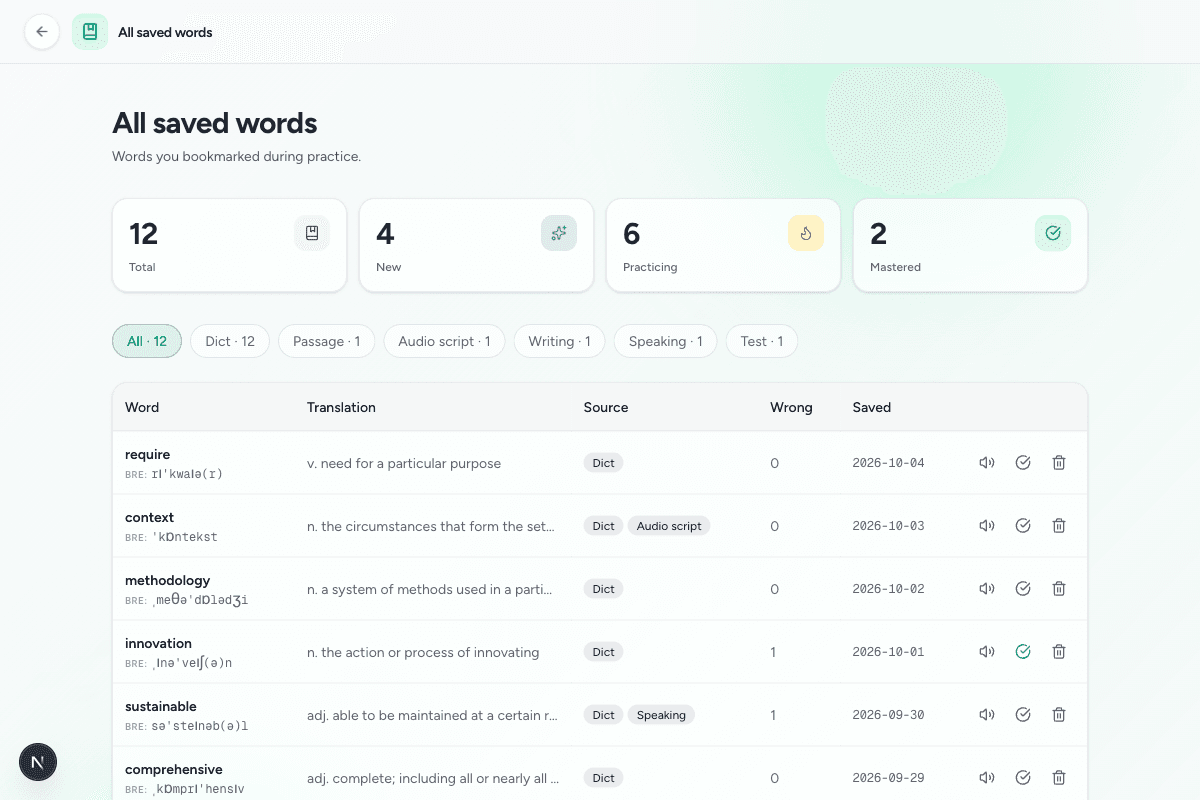
Browse the word list
Study academic words with definitions, examples, and IELTS-specific usage notes.
- Focus on words relevant to your target topics
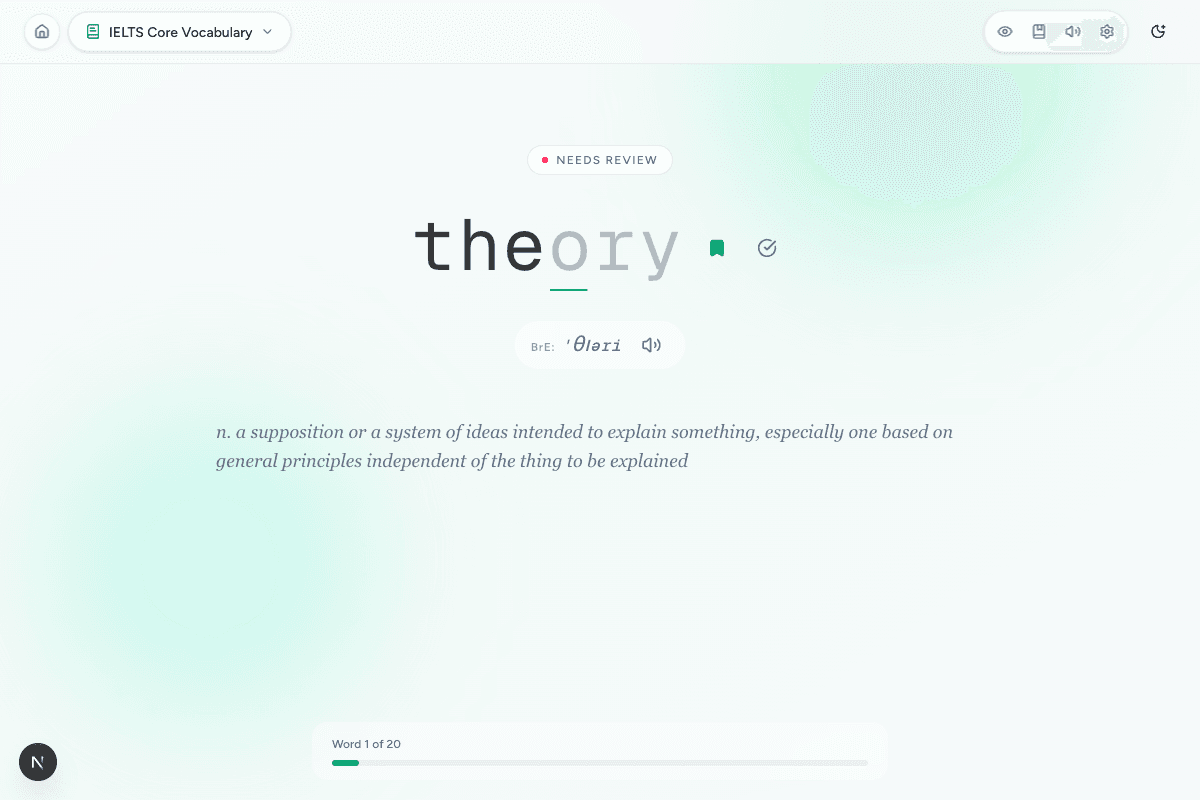
Take a quiz
Test your knowledge with matching quizzes that reinforce meaning and usage.
- Review wrong answers immediately
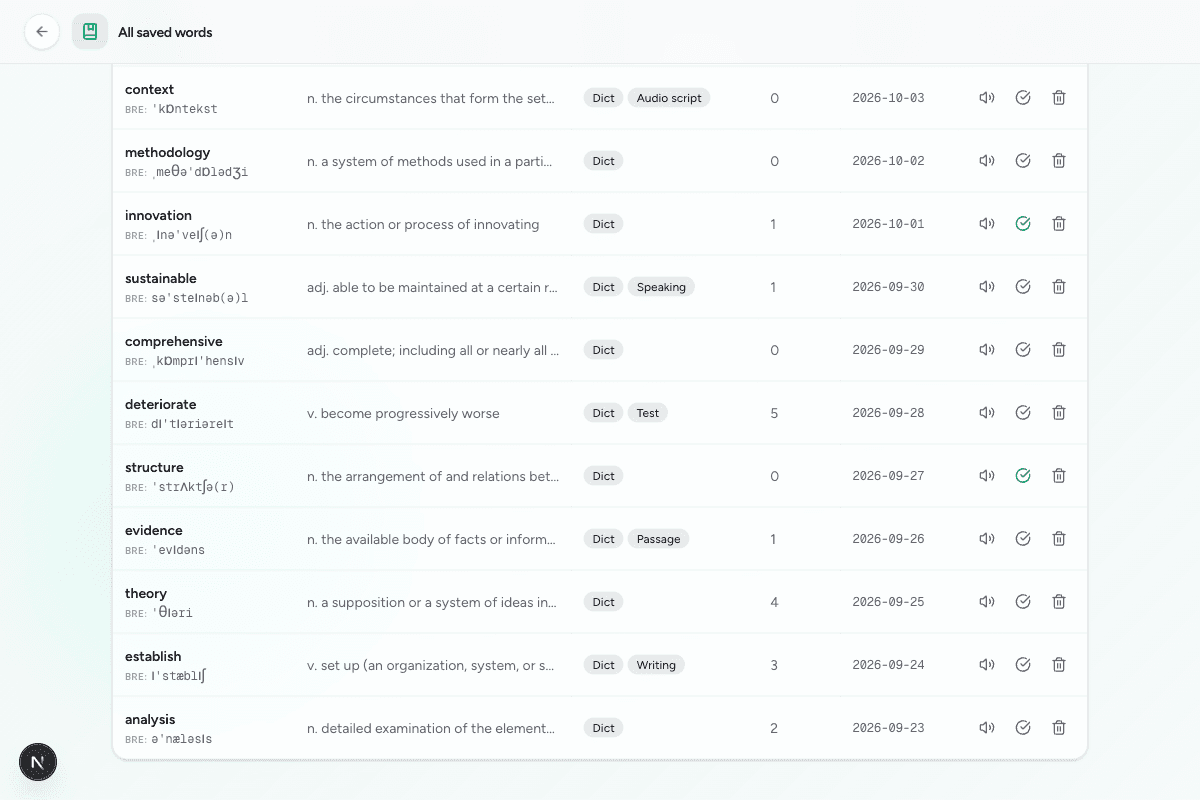
Track spaced repetition
Words you miss appear more often, while known words move to longer intervals.
- Practice daily for best retention
Official IELTS sources
The exam-format facts on this page are checked against official IELTS resources. Retrieved 2026-09-05.
Ready to build your IELTS vocabulary?
Start a free vocabulary session and track your progress.
Start Vocabulary Practice