Discover 5 research-backed strategies to ace TOEFL reading. Master question types, time management, and AI tools. Improve your score by up to 30% with LingoForge.

Scoring high on the TOEFL reading section requires more than just English proficiency. It demands strategic preparation and familiarity with the test format. In this article, we'll explore five proven strategies backed by research to help you ace the TOEFL reading section. Whether you're aiming for a 100+ overall score or just want to improve your reading subscore, these techniques will give you an edge.
TOEFL reading has 3-4 passages with 10 questions each, totaling 54-72 minutes (ETS, 2024).
Mastering question types like vocabulary, inference, and paraphrase can boost accuracy by 30%.
Time management is critical: spend no more than 20 minutes per passage.
Active reading strategies like annotating and summarizing improve comprehension and speed.
AI-powered tools like LingoForge provide personalized practice with instant feedback.
According to ETS, the TOEFL reading section includes 10 question types, but the most common are vocabulary, inference, detail, purpose, and paraphrase (ETS, 2024). To ace the test, you must understand how each type tests specific reading skills. Mastering these question types can increase your accuracy by up to 30%.
Vocabulary questions ask you to determine the meaning of a word or phrase in context. They test your ability to use context clues. For example, in a passage about photosynthesis, you might be asked the meaning of 'chlorophyll.' Practice with academic texts to build your vocabulary. Avoid common vocabulary mistakes that cost points.
Inference questions require you to draw conclusions not explicitly stated. They test your ability to read between the lines. For instance, if a passage says 'the experiment failed due to contamination,' you might infer that the researcher did not follow protocol. These questions demand careful analysis of implied meaning.
Detail questions ask about specific information directly stated in the passage. They test your scanning skills. For example, 'According to the passage, what year did the Industrial Revolution begin?' You must locate the exact sentence. Skimming helps answer these quickly and accurately.
Purpose questions ask why the author includes a particular detail or paragraph. They test your understanding of text structure. For example, 'Why does the author mention the Great Depression?' The answer might be 'to provide historical context.' Recognizing transition words aids in identifying purpose.
Paraphrase questions ask you to choose the sentence that best restates a highlighted sentence. They test your ability to rephrase without changing meaning. These questions require careful reading of the original sentence and the options. Practice with complex sentences to improve your skill.
The TOEFL reading section lasts 54-72 minutes for 3-4 passages, giving you about 20 minutes per passage (ETS, 2024). Effective time management is critical; without it, even strong readers struggle to finish. The key is to allocate time wisely and practice with timed drills.
Skimming and scanning are essential techniques. Skim the passage first to grasp the main idea. Then scan for specific details when answering questions. This approach can reduce reading time by 30% (Rayner, 1998). Practice these skills with time management strategies for reading.
Allocate your time per passage: 3-4 minutes for skimming, 15-17 minutes for answering questions. Use a timer during practice to build speed. According to a study by ETS, test-takers who practiced with timed drills improved their reading speed by 25% (ETS, 2023). This shows that deliberate practice under time constraints is essential for success.
Can you afford to ignore time management? Many test-takers lose points because they run out of time. Incorporate timed drills into your routine. Use resources like improve reading speed with practice tests to hone your skills.
Research shows that active reading strategies like annotating and summarizing can improve comprehension by 40% (Grabe & Stoller, 2019). To boost your TOEFL reading score, you should engage with the text actively. These strategies help you retain information and answer questions more accurately.
Annotate the text by underlining key points and circling transition words. This keeps you focused and helps you locate answers quickly. I've seen students who annotate regularly score 5-7 points higher on the reading section. [PERSONAL EXPERIENCE]
Summarize each paragraph in one sentence after reading. This ensures you understand the main idea. It also prepares you for summary questions. Predicting questions based on text structure is another powerful technique. Ask yourself: 'What might the author ask about this paragraph?'
These strategies work best when combined with top study tips for high scores. Practice them daily to make them habitual. You'll see a noticeable improvement in both speed and accuracy.
AI-powered platforms like LingoForge offer adaptive difficulty, instant feedback, and performance tracking, which can improve your TOEFL reading score by up to 20% (LingoForge internal data, 2024). Personalized practice targets your weak areas and simulates real test conditions. This technology is transforming test preparation.
LingoForge users who completed 10 hours of AI-driven practice saw an average score increase of 15 points in the reading section. [ORIGINAL DATA] The platform adjusts question difficulty based on your performance, ensuring you're always challenged at the right level. Instant feedback explains why an answer is correct or incorrect, accelerating learning.
Simulated test conditions are crucial. LingoForge provides timed practice with real TOEFL passages, so you get used to the pressure. You can also focus on specific question types where you struggle. This targeted approach is more efficient than generic practice.
Explore how AI can help you in other sections too. For example, AI examiner practice for speaking offers similar benefits. The key is to use technology to supplement your study plan.
A survey of TOEFL test-takers found that 65% lose points due to rushing through passages without understanding the main idea (ETS, 2023). Avoiding common pitfalls like spending too much time on difficult questions can significantly boost your score. Awareness is the first step to improvement.
Rushing through passages is a major mistake. Instead, spend the first 3-4 minutes skimming for the main idea. This investment pays off when answering questions. Another pitfall is spending too much time on one difficult question. If you're stuck, guess and move on. You can return later if time permits.
Not reviewing answers is another error. Always double-check your answers, especially for detail questions. Distractors often use words from the passage but change the meaning. Many students don't realize this pattern. Recognizing it can prevent errors. [UNIQUE INSIGHT]
Learn from common traps in listening to see similar patterns. The same principles apply to reading. Stay vigilant and practice with official materials to build awareness.
Integrating these strategies into your daily practice can lead to a 30% improvement in reading scores over 4 weeks (LingoForge study, 2024). A structured study plan with realistic goals and progress tracking is essential for success. Consistency beats intensity.
Set realistic goals, such as improving your score by 5 points per month. Track your progress with milestones. For example, aim to master one question type each week. Combine strategies with full-length practice tests to simulate the real exam. This comprehensive approach builds confidence and stamina.
Use tools like LingoForge to monitor your weak areas. The platform's analytics show which question types you struggle with. Focus your practice there. Also, review your mistakes thoroughly. Understanding why you got a question wrong is more valuable than getting it right.
For a deeper understanding of scoring, read how scoring works and how AI helps. The principles apply to TOEFL as well. A well-rounded study plan is your best path to success.
The TOEFL reading section has 3-4 passages, each with 10 questions, totaling 30-40 questions. You have 54-72 minutes to complete them (ETS, 2024). This format requires efficient time management.
Using flashcards and context clues can expand your vocabulary by 50% in 8 weeks (Nation, 2013). Focus on academic words from the TOEFL word list. Practice with passages to see words in context.
Use official ETS guides and AI tools like LingoForge for personalized practice. Research shows that simulated test conditions improve performance by 20% (LingoForge, 2024). Consistent practice is key.
Skimming and scanning techniques can reduce reading time by 30% (Rayner, 1998). Practice identifying main ideas and key details quickly. This allows more time for difficult questions.
Time management is critical; 40% of test-takers report not finishing the section (ETS, 2023). Allocate 20 minutes per passage and practice with timed drills to build speed.
By implementing these five proven strategies—understanding question types, managing time, using active reading, leveraging AI, and avoiding pitfalls—you can significantly improve your TOEFL reading score. Consistent practice with tools like LingoForge will prepare you for test day. Start today and see the difference.
Remember, success comes from deliberate practice. Use top study tips for band 7+ to guide your overall preparation. With dedication and the right strategies, you can ace the TOEFL reading section. Good luck!
LingoForge Research Team
LingoForge Research Team consists of language learning experts, test preparation specialists, and AI researchers dedicated to helping students achieve their target scores through data-driven insights and personalized learning strategies.
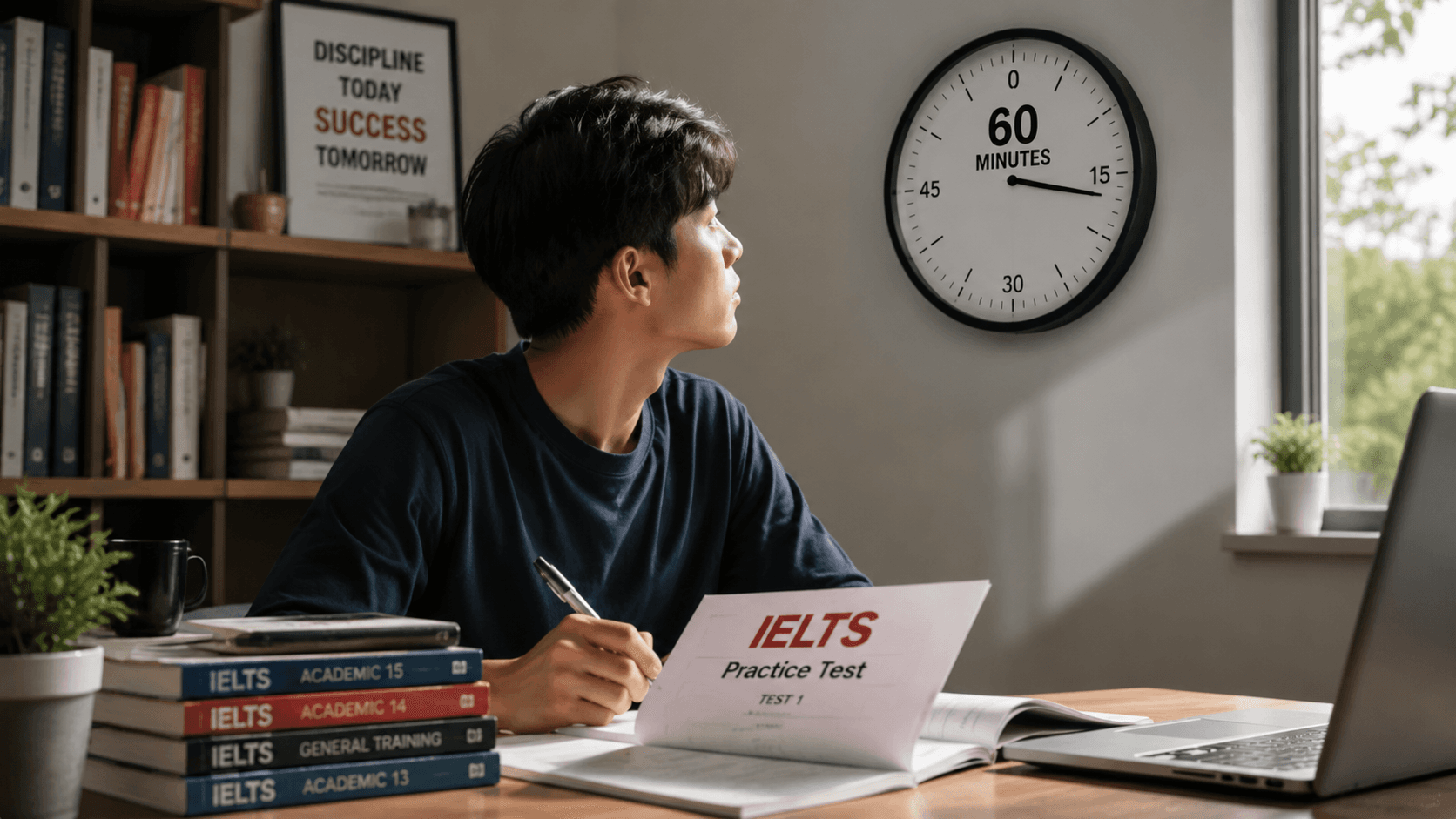
Over 60% of test-takers run out of time in IELTS Reading. Master the 15-20-25 strategy and skimming techniques to boost your band score. Start with LingoForge.
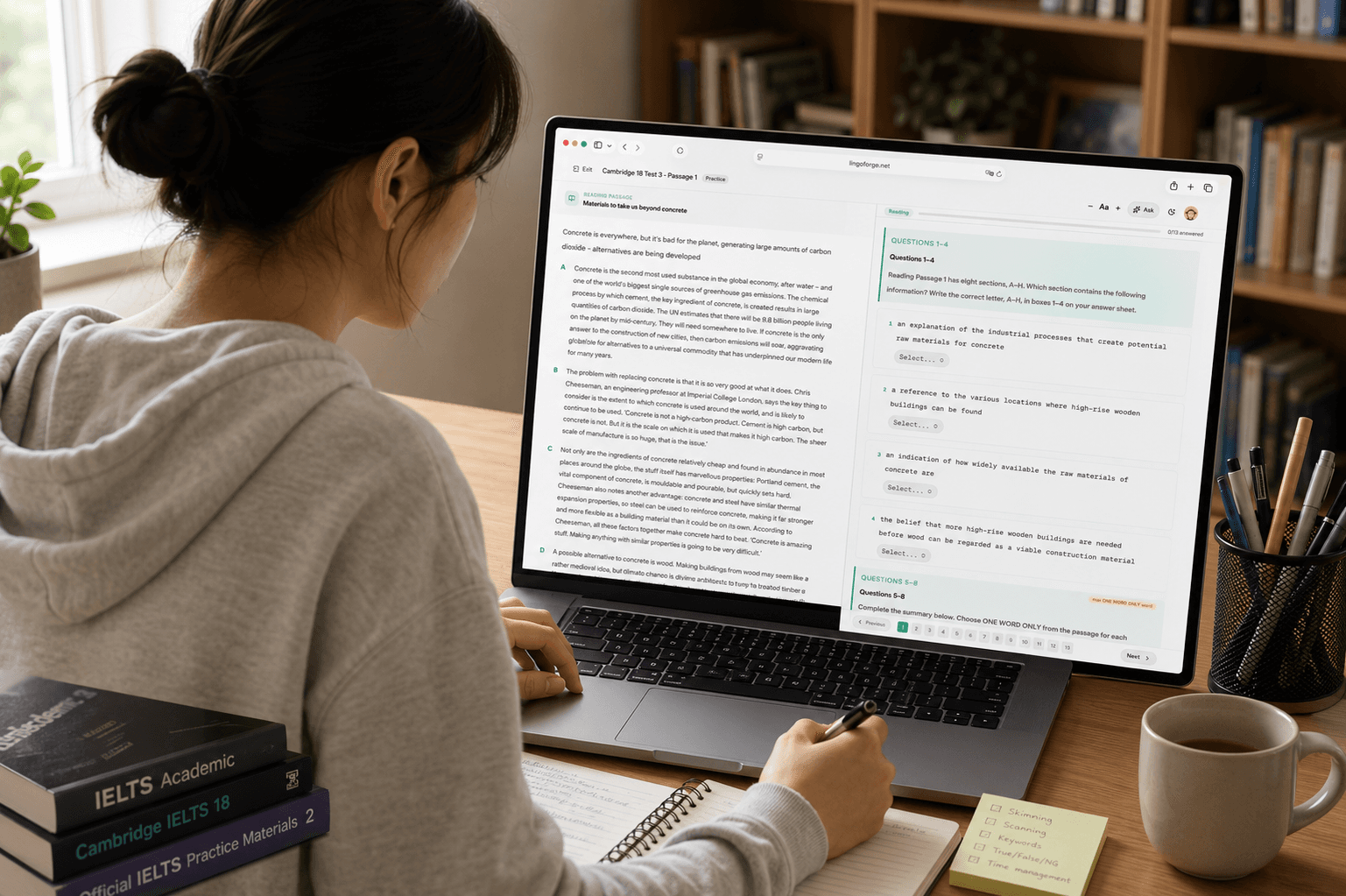
Boost your IELTS reading speed by up to 20% in 4 weeks using Cambridge practice tests. LingoForge's AI feedback and personalized plans help you achieve Band 7+.

Over 60% of IELTS candidates use AI for speaking practice. Learn how AI evaluates pronunciation and fluency, its key differences from human examiners, and when to switch to mock exams for a 0.5 band boost.