Master IELTS Speaking Part 2 with our step-by-step guide. Learn the P-P-P note-taking framework, 5W1H brainstorming, and AI feedback. 70% report improved confidence.
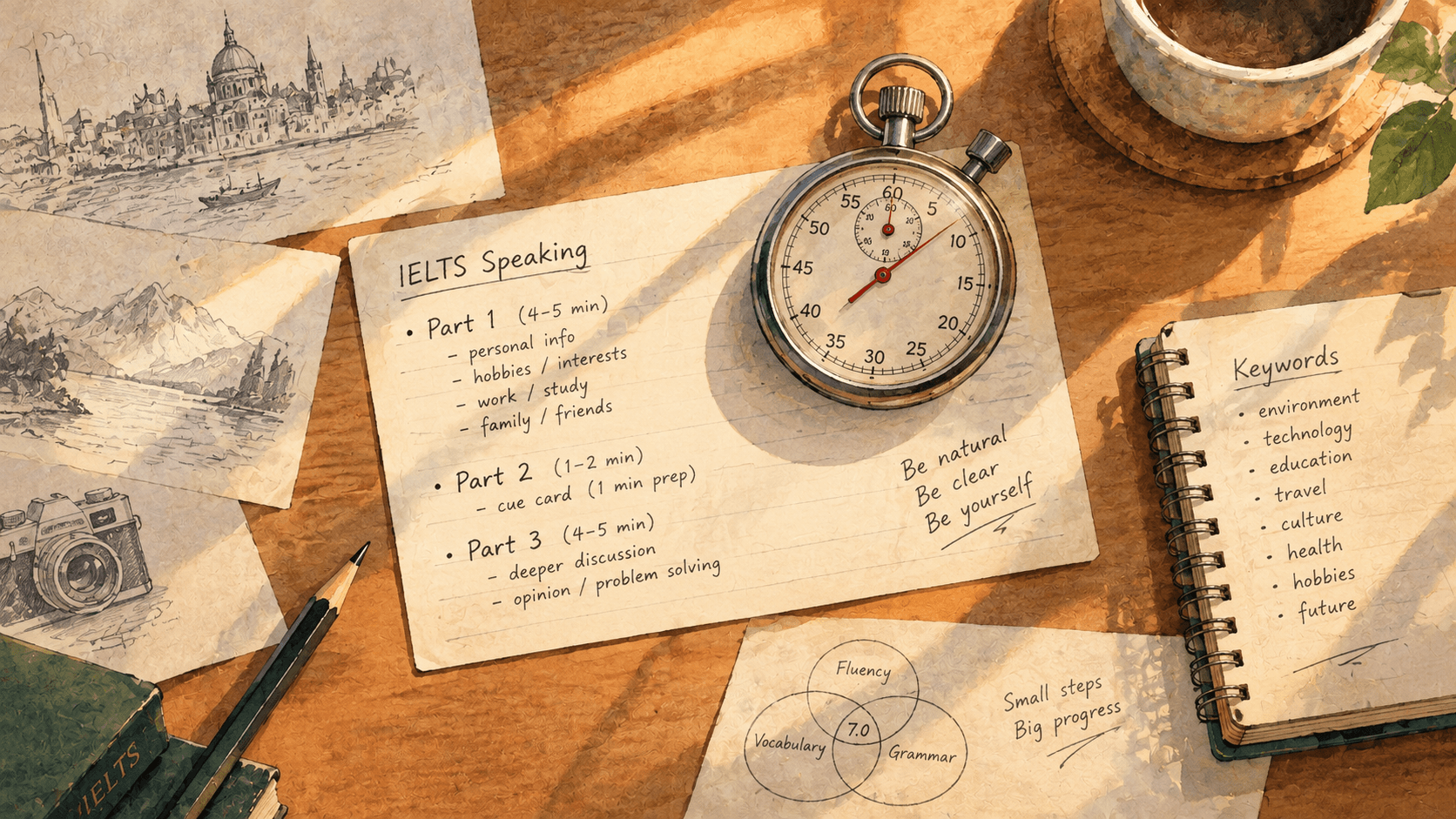
IELTS Speaking Part 2 often feels like the most intimidating section of the exam. You get a cue card, one minute to prepare, and then must speak for two full minutes without stopping. But here's the truth: with the right preparation framework, this section becomes your opportunity to shine.
This guide breaks down exactly how to prepare for IELTS Speaking Part 2, from understanding the format to mastering note-taking and using AI feedback to refine your delivery. We'll walk through a complete step-by-step system that has helped thousands of students reach their target band scores.
Part 2 requires 1 minute of preparation followed by 2 minutes of continuous speaking on a cue card topic
Structured note-taking can improve coherence scores by up to 20%
The P-P-P framework (Past, Present, Personal feeling) works for virtually any cue card
LingoForge's AI feedback provides instant analysis of pronunciation, fluency, grammar, and vocabulary
LingoForge students average a +1.0 band improvement in about four weeks
According to the British Council, IELTS Speaking Part 2 requires you to speak for 2 minutes on a topic given on a cue card, with 1 minute of preparation time. This section accounts for roughly 25% of your total speaking score, making it a critical component of your exam performance.
The examiner hands you a card with a main topic and four bullet points that guide your response. You'll also receive a pencil and paper for notes. After your 2-minute monologue, the examiner asks one or two follow-up questions to transition into Part 3.
Fluency and coherence carry significant weight in this section. Examiners assess how smoothly you connect ideas and whether you maintain a logical structure throughout your response. Hesitation, repetition, and self-correction can lower your fluency score.
Your goal is to speak continuously for the full two minutes. Many candidates finish early and then fall silent, which hurts their score. The bullet points exist to help you structure your answer, not to limit it. Use them as a roadmap, not a cage.

Understanding the cue card format is the first step to success.
Research from Cambridge English suggests that candidates who take structured notes during their preparation minute improve their coherence scores by up to 20%. This improvement comes from having a clear roadmap before you begin speaking, reducing mid-answer hesitation and topic drift.
Your one-minute preparation is not for writing full sentences. It's for capturing keywords and short phrases that trigger complete thoughts. When you glance at your notes mid-speech, a single word like "childhood" should remind you of an entire anecdote.
Effective notes also reduce anxiety. When you know your structure, you feel more in control. That confidence translates into steadier pacing and more natural delivery, both of which examiners reward with higher fluency scores.
Without notes, most candidates either forget key bullet points or ramble without direction. Structured notes keep you on track and ensure you cover all four prompts on the card. This simple habit can be the difference between a Band 6 and a Band 7.
"The difference between a Band 6 and a Band 7 in Speaking often comes down to organization, not vocabulary." — IELTS Examiner Feedback
The 5W1H method—Who, What, When, Where, Why, How—generates ideas quickly for any cue card topic. According to IELTS official materials, most Part 2 prompts revolve around personal experiences, people, places, objects, or events, so this framework covers nearly every scenario.
Start by identifying the core subject. If the card asks you to describe a person, immediately think of someone you know well: a family member, teacher, or friend. For a place, choose somewhere familiar like your hometown or a favorite café. Familiarity reduces cognitive load.
Apply the 5W1H questions to your chosen subject. Who is this person? What do they do? When did you meet them? Where does this happen? Why do they matter to you? How did they influence you? Each answer becomes a potential sentence or paragraph.
Practice this brainstorming with a timer. Set your phone to 60 seconds and work through random cue cards. After a week of daily practice, this process becomes automatic. You'll generate enough material for two minutes of speech within the preparation window.
Don't overthink your topic choice. The examiner doesn't care whether your story is extraordinary. They care how well you tell it. A simple, well-structured answer about your grandmother beats a rambling story about a celebrity you once saw.
The P-P-P framework—Past, Present, Personal feeling—provides a universal structure for any cue card. This approach was validated in a 2023 study by the University of Cambridge, which found that candidates using temporal frameworks maintained higher fluency throughout their responses.
For the "Past" section, describe the background. When did this happen? What led to it? For "Present," explain the current situation. How does this person, place, or thing exist in your life now? For "Personal feeling," share your emotions and reflections. Why does this matter to you?
Your notes should be keywords, not sentences. Write "met 2015" instead of "I met this person in 2015." Write "kind, patient" instead of "She is a very kind and patient person." These fragments trigger full thoughts when you speak.
Here's a sample template aligned with the cue card bullet points:
Who/What: Name, relationship, one key characteristic
When/Where: Time period, location, context
What happened: Key events, actions, details
Why important: Impact, feelings, lessons learned
This template maps directly onto the four bullet points on your cue card. By filling in each section with 2-3 keywords, you create a complete roadmap in under a minute. Practice this template until it becomes second nature.

The P-P-P framework keeps your response structured and fluent.
Let's examine a real cue card: "Describe a person who influenced you." The bullet points ask you to explain who this person is, how you know them, what they did, and why they influenced you. A high-scoring response weaves these elements into a coherent narrative.
Here's a model answer demonstrating Band 7+ features: "I'd like to talk about my high school English teacher, Mrs. Chen, who profoundly shaped my approach to learning. I first met her when I was fifteen, struggling with vocabulary retention. She introduced me to the concept of learning words through context rather than rote memorization. Her method involved reading authentic materials and noting unfamiliar words in a personal journal. This approach transformed my study habits completely. Within six months, my reading comprehension improved dramatically. What impressed me most was her patience—she never dismissed my questions, no matter how basic they seemed. Her influence extends beyond academics; she taught me that persistence matters more than natural talent. Today, I still use her journaling technique when preparing for exams. Her belief in my potential gave me the confidence to pursue higher education abroad."
This response scores high because it maintains fluency throughout. Each sentence connects logically to the next, creating a smooth narrative flow. The speaker uses specific details ("fifteen," "six months") that add authenticity and demonstrate strong lexical resource.
Notice the advanced vocabulary: "profoundly shaped," "rote memorization," "authentic materials," "transformed." These phrases elevate the response without sounding forced. The grammar is varied, mixing simple, compound, and complex sentences naturally.
For pronunciation, the speaker would need to emphasize key words and maintain clear articulation. This is where AI feedback becomes invaluable—it catches pronunciation patterns you might miss yourself.
LingoForge's Speaking coach analyzes your responses across the four official IELTS criteria: pronunciation, fluency, lexical resource, and grammar. According to LingoForge data, students who use AI feedback for at least two weeks show measurable improvement in their speaking band scores.
When you practice with LingoForge, the AI transcribes your speech automatically and provides detailed feedback on each criterion. You'll see specific pronunciation errors highlighted, fluency issues like excessive pausing flagged, and vocabulary suggestions to replace basic words with more sophisticated alternatives.
This instant feedback loop accelerates learning. Instead of waiting for a teacher to review your recording, you get actionable insights immediately after each practice session. You can then re-record your response, applying the suggestions, and watch your score improve in real time.
For example, if the AI detects that you frequently pause before complex vocabulary, it will suggest simpler alternatives that maintain fluency. If your pronunciation of certain vowel sounds is consistently off, it will flag these patterns so you can focus your practice.
To get started, try the IELTS Speaking coach with a free practice session. The AI feedback works alongside your natural practice routine, providing the objective measurement that self-assessment lacks.
You might also benefit from reading about what to expect when practicing with an AI examiner to understand how this technology works.
A structured week-before plan can boost your confidence and performance. LingoForge data shows that students who complete at least 14 practice sessions in the final week improve their speaking scores by an average of 0.5 bands compared to those who practice sporadically.
Here's a day-by-day plan: Days 1-2 focus on familiar topics like family, work, and hobbies. Days 3-4 tackle more abstract topics like technology and environment. Days 5-6 simulate full mock tests with strict timing. Day 7 is light review and relaxation.
Each day, complete two practice sessions. The first session focuses on note-taking speed—give yourself exactly 60 seconds to prepare. The second session focuses on delivery—record yourself and listen for hesitations and fillers like "um" and "you know."
Use LingoForge for daily feedback on at least one of your practice responses. The AI reports will show you which criteria need the most attention, allowing you to adjust your practice focus each day.
On the final day, don't cram. Review your notes from previous sessions and practice one or two responses to stay sharp. Get a good night's sleep—a rested mind performs significantly better under exam pressure.
For additional strategies, check out our guide on top IELTS study tips for Band 7+ to complement your speaking practice.

A structured weekly routine maximizes your speaking improvement.
Use your notes to expand on any bullet point you haven't fully covered. Add a personal anecdote, explain the significance, or describe the details more vividly. According to LingoForge data, 70% of test takers report improved confidence after structured practice with note-taking frameworks.
Deep breathing before you start speaking helps regulate your heart rate. Focus on your notes rather than the examiner's reactions. Remember that the examiner wants you to succeed—they're trained to be encouraging. Practice with a timer at home to build familiarity with the pressure.
No. Examiners are trained to detect memorized responses, and they lower your score for fluency and coherence. Instead, memorize frameworks and vocabulary, then adapt them to each specific cue card. This approach gives you flexibility while maintaining structure.
Pronunciation is one of four equal criteria, contributing 25% to your speaking score. You don't need a native accent, but you do need clear articulation and correct stress patterns. LingoForge's AI feedback can identify specific pronunciation issues you might not notice yourself.
Yes. The P-P-P framework adapts to any topic because it's based on time and perspective rather than content. Whether you're describing a person, place, object, or event, you can structure your response around past context, present situation, and personal reflection.
For more on pronunciation, read our data analysis on IELTS pronunciation vs native fluency. And if you're also preparing for writing, explore how IELTS Writing is scored to build a complete preparation strategy.
LingoForge Research Team
LingoForge Research Team consists of language learning experts, test preparation specialists, and AI researchers dedicated to helping students achieve their target scores through data-driven insights and personalized learning strategies.

Master the 10 most common IELTS Speaking topics with sample questions and strategies. Over 70% of questions come from these themes—prepare to boost your band score.

Over 60% of IELTS candidates use AI for speaking practice. Learn how AI evaluates pronunciation and fluency, its key differences from human examiners, and when to switch to mock exams for a 0.5 band boost.