
What is the TOEFL Listening section format in 2026?
TOEFL Listening is a multistage adaptive section of about 29 minutes with roughly 47 items. You hear each audio once: short Listen and Choose a Response items, campus conversations, announcements, and academic talks. Questions follow each audio. It is scored on the 1-6 band scale.
Listen and Choose a Response
You hear a single short sentence or question — a remark someone might make in daily campus life — and pick the most natural response. These are the fastest items in the section, but they test real listening, not reading.
Typical situations
How to answer well
- • Listen for function, not keywords — the right response matches the speaker's intent
- • Eliminate responses that are grammatically fine but socially off-topic
- • Answer quickly; these items are designed to be fast
- • If two options seem plausible, pick the one that replies directly to what was said
Listen to a Conversation
A dialogue between a student and a professor, staff member, or another student — office hours, registration, housing, assignments. Questions ask about purpose, details, attitude, and what the speaker implies.
Typical situations
How to answer well
- • Note who wants what from whom — most questions hinge on the speaker's goal
- • Catch attitude signals: hesitation, surprise, relief
- • Write the problem in three words while listening; answers reference it
- • Implication questions replay the tone, not the words
Listen to an Announcement
A single speaker delivers a campus announcement — policy changes, event details, deadlines, procedures. Shorter than a talk but denser in facts: dates, places, requirements.
Typical situations
How to answer well
- • Anchor on the who/what/when/where — detail questions target these directly
- • Note any action the listener is expected to take
- • Dates and conditions are the most tested details
- • Purpose questions ask why the announcement exists at all
Listen to an Academic Talk
A professor-style mini-lecture or classroom discussion on an academic subject — the closest task to the classic TOEFL lecture. Questions cover main idea, supporting details, organization, and the speaker's purpose.
Typical subjects
How to answer well
- • Track the talk's structure: claim → example → contrast → conclusion
- • Write one word per new idea, not sentences — you cannot pause the audio
- • Examples exist to support points; detail questions test the point, not the example
- • If the professor changes direction ('but', 'however', 'actually'), note what follows
Question types you will see
Whatever the audio, questions fall into a small set of repeating types.
Gist / Main purpose
Why does the conversation or talk happen? Answer from the whole audio, not the first lines.
Detail
A specific fact from the audio — a date, a requirement, a reason. This is what your notes are for.
Function / Attitude
What the speaker means beyond the words — sarcasm, doubt, enthusiasm. Often replays a short excerpt.
Inference / Implication
What can you conclude that was never said directly? Eliminate answers that restate facts instead of inferring.
Organization
Why does the speaker mention an example or sequence? Connect the detail to the point it supports.
Note-taking for one-play audio
Every audio plays exactly once. A light, fast note system beats a perfect one you cannot maintain.
Abbreviate everything
Notes are for your eyes only — cut every word to its skeleton.
- Use arrows for cause/change (→), x for negatives, + for emphasis
- Drop vowels and articles: 'assignment deadline moved' → 'asgn ddl →'
- Initials for speakers: S for student, P for professor
Note structure, not sentences
Questions target the audio's architecture — what was claimed, challenged, and concluded.
- One line per new idea; indent examples under the point they support
- Mark transitions (but, however, so, actually) — they predict questions
- Circle names, dates, numbers: the highest-value details
Balance listening vs. writing
If you are writing more than you are hearing, your notes are too heavy.
- Cap yourself at a few words per idea — miss nothing to write everything
- During short items, often no note beats a rushed note
- Practice the same symbols every session so they become reflex
How Listening is scored on the 1-6 band scale
Raw points from both adaptive modules convert to a section band from 1 to 6, aligned to CEFR. Your report also shows a comparable 0-120 total during the transition period.
Follows fast academic talks including implied meaning and speaker attitude.
Catches main ideas and most details in campus and academic audio.
Understands clear, slower speech; loses threads in dense or fast talks.
Catches familiar words and short exchanges. Build daily-life listening first.
How to practice
Practice TOEFL Listening on LingoForge
Three steps from pressing play to reviewing your misses.
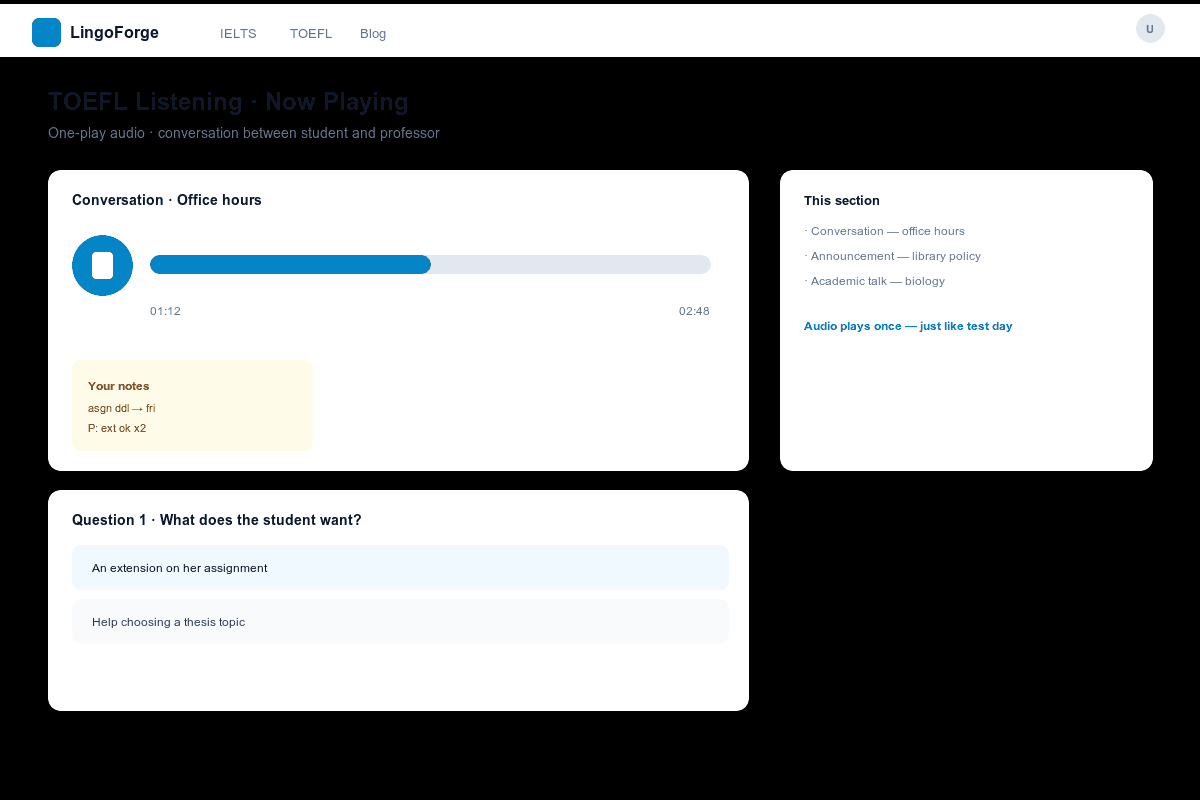
Play the audio once
Each recording plays a single time — exactly like test day. Take light notes while it runs.
- Resist replaying on your first pass
- Keep a scratch pad beside you
Answer the questions
Respond to the question set that follows the audio — gist, detail, function, and inference items.
- Answer from notes and memory, not guesses about the topic
- Move on quickly; your first instinct after one listen is usually right
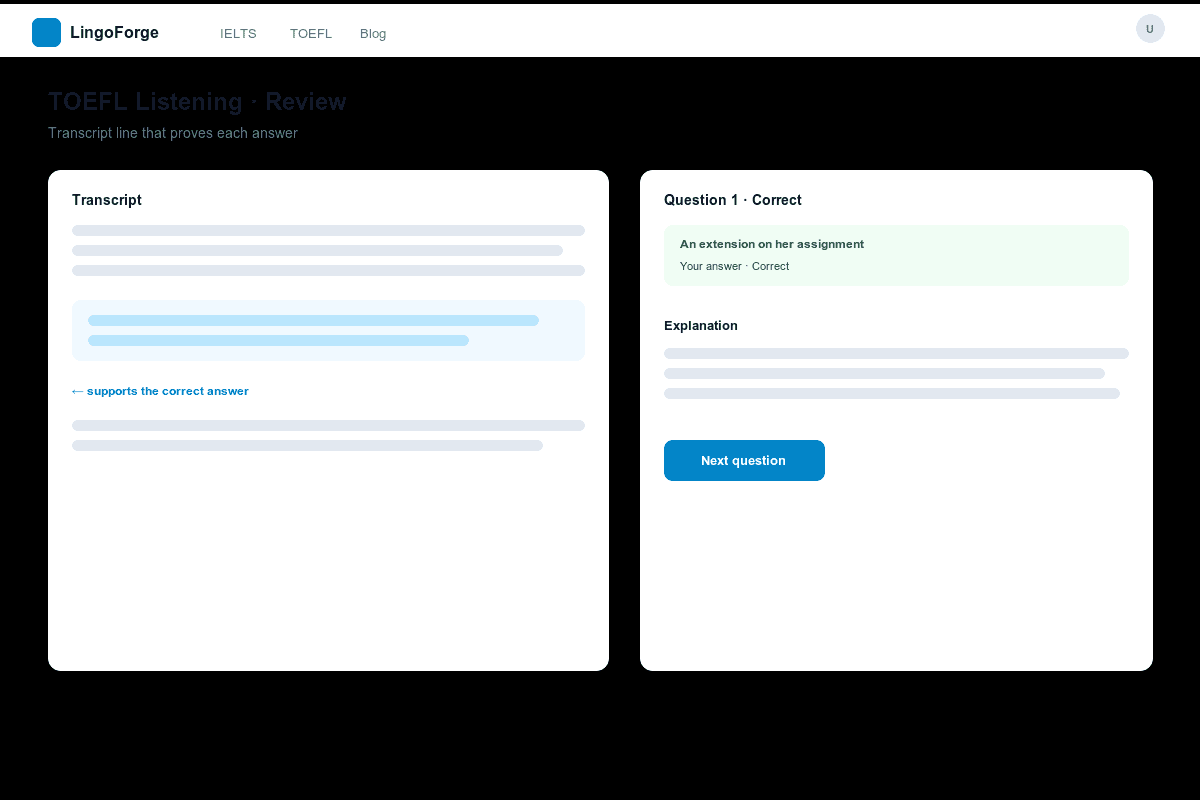
Review with the transcript
Replay with the transcript and explanations to see exactly which sentence each answer came from.
- Find the transcript line that proves each correct answer
- Note whether you missed the fact or the function
Official TOEFL sources
The exam-format facts on this page are checked against official ETS resources. Retrieved 2026-11-03.
Ready to practice TOEFL Listening?
Start a free Listening session and train your ear with one-play audio and instant review.
Practice TOEFL Listening