
How long is the TOEFL iBT and what does a mock test cover?
The 2026 TOEFL iBT takes about 90 minutes: Reading (~30 min, adaptive), Listening (~29 min, adaptive), Writing (~23 min, three tasks), and Speaking (~8 min, two tasks). A LingoForge mock test simulates the full flow and returns band-scale results per section.
What a full mock test includes
All four sections in exam order, with the real timing rules.
Reading
~30 minMultistage adaptive — router module plus a second module matched to your level. Complete the Words, daily-life texts, academic passages.
Listening
~29 minAdaptive audio section — quick responses, conversations, announcements, and academic talks, each played once.
Writing
~23 minBuild a Sentence items, a 7-minute email, and a 10-minute Academic Discussion post.
Speaking
~8 minListen and Repeat items followed by the four-question Interview — 45 seconds per answer, no prep.
Why mock tests matter
Section practice builds skill; mocks build the score.
Adaptive pressure is different
Early accuracy shapes your second module — mocks teach you to treat the first module like it counts double.
Stamina is a skill
90 minutes of continuous English is its own challenge; only full-length practice builds it.
Band predictions, not guesses
A full test gives a realistic score estimate — single sections can't show how fatigue drags your Speaking.
Timing habits get exposed
You don't know if you rush or stall until the whole clock runs.
How to use mock tests in your prep
Quality over quantity — one well-reviewed mock beats three rushed ones.
Simulate exam conditions
One sitting, no pauses, a real microphone, scratch paper for notes — the closer the rehearsal, the smaller the test-day surprise.
Schedule them weekly
A mock every 1-2 weeks gives a trend line; daily mocks just burn material.
Review for a full day after
The test is half the work — the other half is mining every miss for its cause.
Track bands, not feelings
Log section bands each time; the trend tells you where the next week of practice goes.
Analyzing your results
The score is the summary — the diagnosis is in the details.
Find the weakest section
Your lowest band is where the next point is cheapest.
- Compare all four section bands, not just the total
- A 3.5 in one section drags the overall more than a 5.5 lifts it
- Budget next week's practice toward the gap
Classify every miss
Each wrong answer has a cause — find the pattern.
- Knowledge gap: didn't know the word, rule, or concept
- Misread question: knew it, answered the wrong thing
- Rushed: right skill, wrong pacing
- Second-guess: changed a correct answer — trust first instincts
Convert misses into practice
Every miss maps to a section exercise — close the loop.
- Reading vocabulary misses → vocabulary drilling
- Listening detail misses → note-taking practice
- Writing structure misses → task-specific templates
- Speaking delivery misses → Listen and Repeat drills
AI-powered scoring
Instant results on the same scale the real test reports.
1-6 band results
Section bands and an overall score on the new scale, with a 0-120 comparable total.
Rubric-aligned feedback
Writing and Speaking scored against the official rubric dimensions, not a generic check.
Section-level analysis
Which task types and question categories cost you the most points.
Progress history
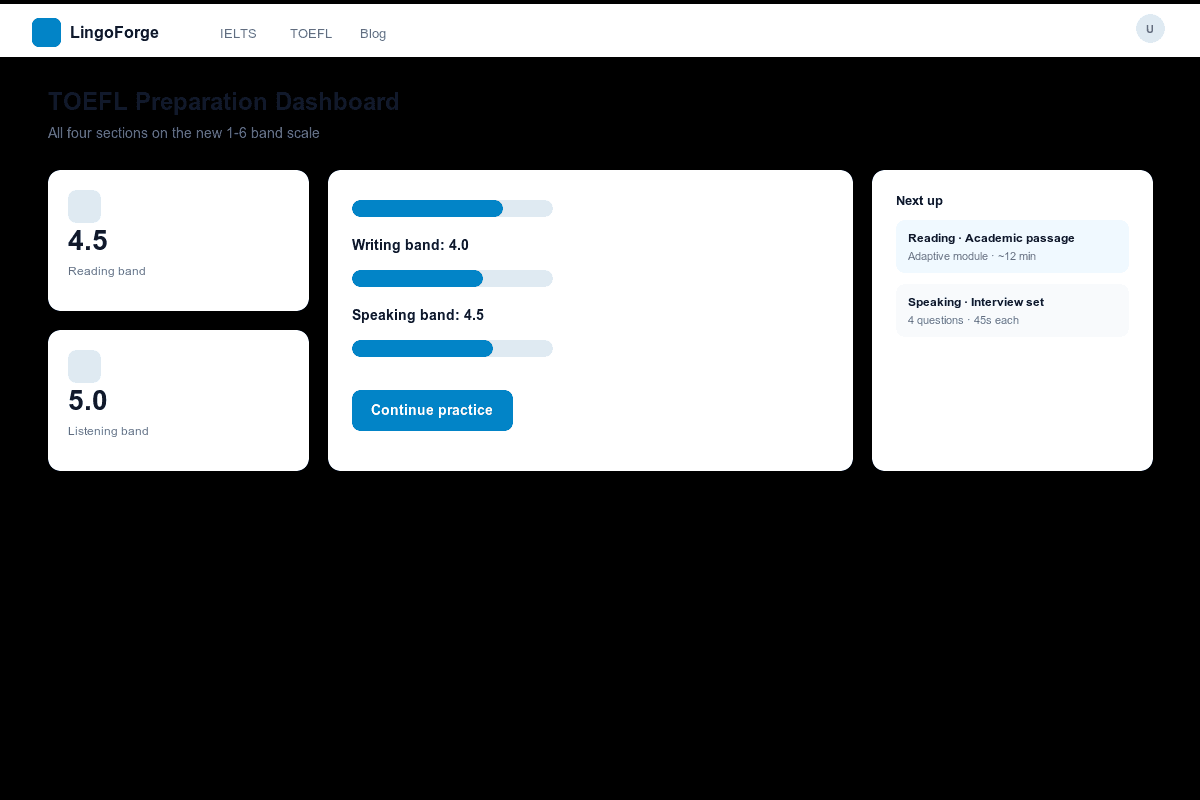
Every attempt saved — watch the band trend across mocks, not just single scores.
Test-day preparation
Small logistics, big score protection.
Sleep beats cramming
The night before, review your error log — don't run a new mock.
Rehearse the routine
ID check, mic test, scratch paper — do them once at home so nothing is new.
Protect the router
Tell yourself before you start: module one decides the ceiling — first questions get full focus.
Plan for the clock you can't see
Adaptive sections hide module boundaries — pace steadily instead of hunting for the switch.
How to practice
Take a TOEFL mock test on LingoForge
From start to band results in one sitting.
Start a full test
Launch the complete exam flow — all four sections in order with real timing.
- Block 90 uninterrupted minutes
- Use a quiet room and a real microphone
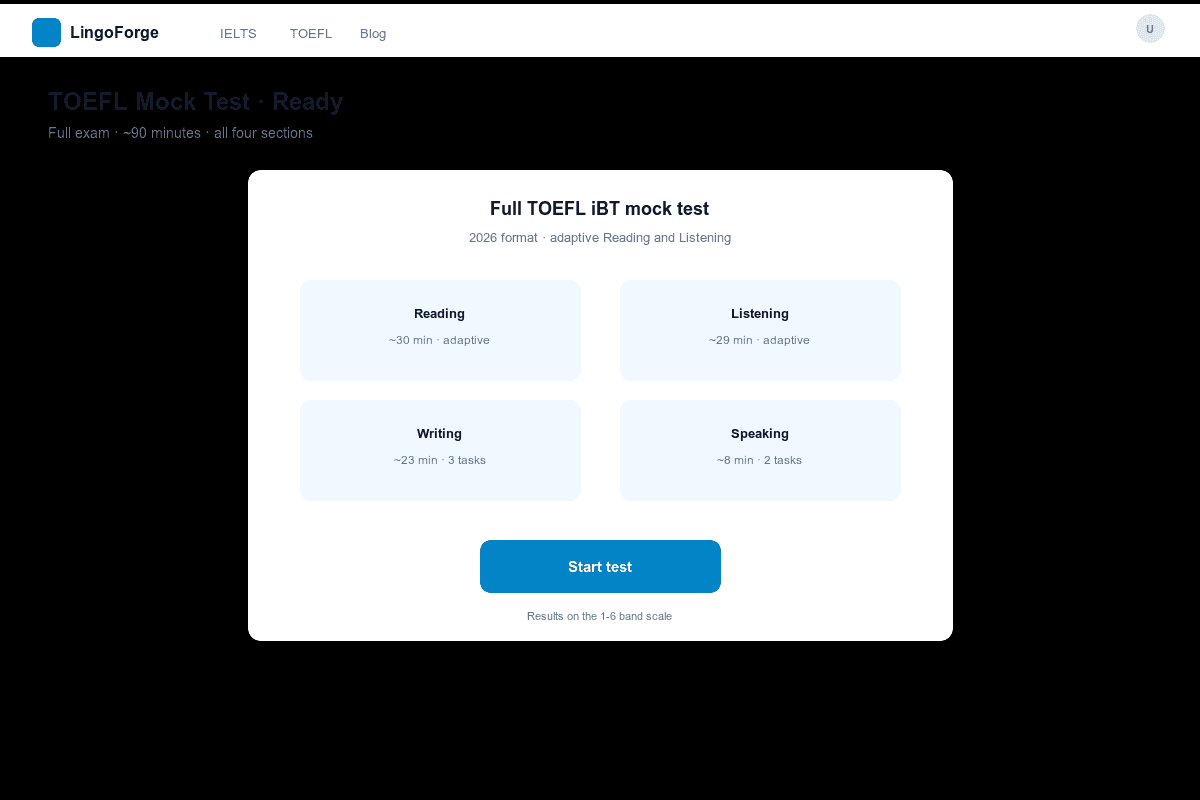
Complete all four sections
Work through Reading, Listening, Writing, and Speaking without pausing, like test day.
- Treat the first module as decisive — it routes your difficulty
- Note-taking paper stays within reach throughout
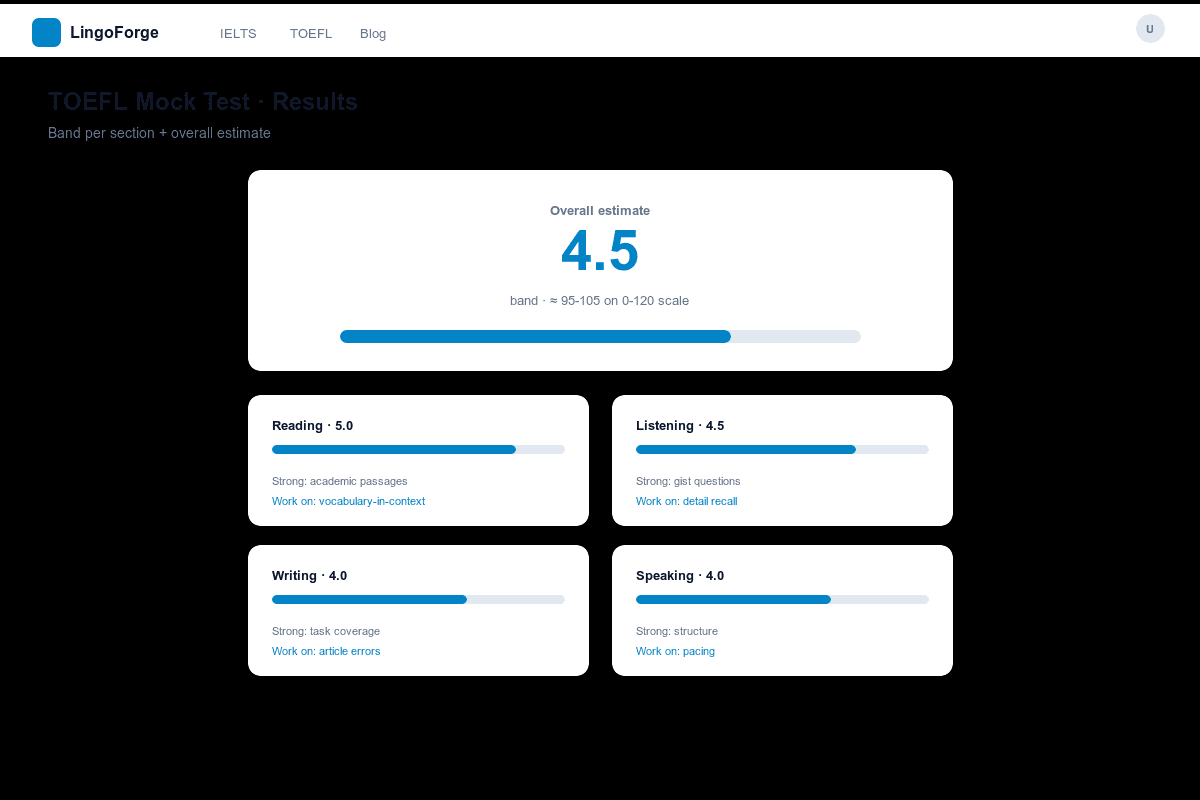
Review band results
Get section bands, overall score, and per-task analysis — then plan the next week.
- Classify every miss by cause before re-testing
- Book your next mock a week out, not tomorrow
Official TOEFL sources
The exam-format facts on this page are checked against official ETS resources. Retrieved 2026-11-03.
Ready to test yourself?
Start a free TOEFL mock test and get your band-scale results today.
Start a mock test