
What is the TOEFL Speaking section format in 2026?
TOEFL Speaking is about 8 minutes with two task types: Listen and Repeat (7 sentences to repeat exactly, getting longer) and Take an Interview (4 questions on one topic, 45 seconds each, no prep time). Responses are recorded and AI-scored on the 1-6 band scale.
Listen and Repeat
You hear a sentence and repeat it back exactly — 7 items that get progressively longer and more complex. Scored on accuracy and intelligibility.
What the sentences cover
How to repeat accurately
- Chunk the sentence. Hold it in 2-3 meaning chunks instead of word-by-word — rhythm preserves length.
- Match the intonation. Copy the speaker's stress pattern; intelligibility includes prosody, not just words.
- Say something always. A partial repeat beats silence — accuracy is scored on what you produce.
- Don't restart. If you stumble, keep going — a fluent near-repeat scores better than a broken perfect attempt.
Take an Interview
A recorded interviewer asks four questions on a single theme. You get 45 seconds per answer and — unlike the old format — no preparation time at all.
Sample interview flow
Topic: Studying abroad
You will hear four questions like:
- Tell me about yourself and your field of study.
- Why do you want to study abroad?
- Describe a challenge you might face and how you would handle it.
- What do you hope to gain from the experience?
A 45-second answer framework
- Answer in the first sentence. With 45 seconds and no prep, your first line must be the answer — not a warmup.
- Use the answer-reason-example arc. Position → one reason → one short example. It fits 45 seconds exactly.
- Build on your previous answer. Interview questions escalate — let each response extend the story you started.
- Finish before the beep. Plan to land your last sentence at ~40 seconds; a clean ending reads as control.
Interview question types & useful phrases
The four questions move from personal to analytical — a predictable arc you can rehearse.
Personal / Background
'Tell me about yourself' or 'Describe your hometown' — warm-up questions testing fluency and basic elaboration.
Opinion / Preference
'Do you prefer studying alone or in a group?' — take a side and give one reason.
Experience / Problem-solving
'Describe a challenge you faced and how you solved it' — past-tense narrative with a resolution.
Hypothetical / Analytical
'How would you adapt to a new culture?' — speculation, conditionals, and structured reasoning.
Phrases that buy you thinking time
- That's an interesting question — I'd say…
- From my experience, …
- The main reason is that…
- A good example of this is…
- If I were in that situation, I would…
- On top of that, …
- So overall, I believe…
How Speaking is scored
Responses are AI-scored on delivery, language use, and topic development, then converted to a 1-6 section band.
Delivery
Intelligibility — pronunciation, pacing, and intonation a proficient speaker understands without effort.
Language use
Grammar accuracy and vocabulary range — varied, correct structures over safe repetition.
Topic development
Full, coherent answers — a clear position, supporting reason, and specific detail inside 45 seconds.
Task completion
Exact repeats in Listen and Repeat; direct, on-topic answers in the Interview.
Common interview themes
Practice answers on the themes ETS uses most — your first question is usually about you.
How LingoForge scores your speaking
Record a response and get AI feedback in seconds — band estimate, transcript, and targeted fixes.
Band-scaled score
Estimated band on the new 1-6 scale with a 0-120 equivalent for comparison.
Pronunciation & fluency
Delivery scored on intelligibility, pacing, and where your prosody breaks down.
Transcript & corrections
Your words transcribed with grammar and vocabulary upgrades inline.
Stronger model answer
A higher-band response to the same question so you can hear the gap.
How to practice
Practice TOEFL Speaking on LingoForge
From prompt to band-level feedback in three steps.
Choose a Speaking task
Pick Listen and Repeat drills or a full Interview set with the real 45-second limit.
- Warm up with Listen and Repeat before the Interview
- Practice with a microphone you'll use on test day
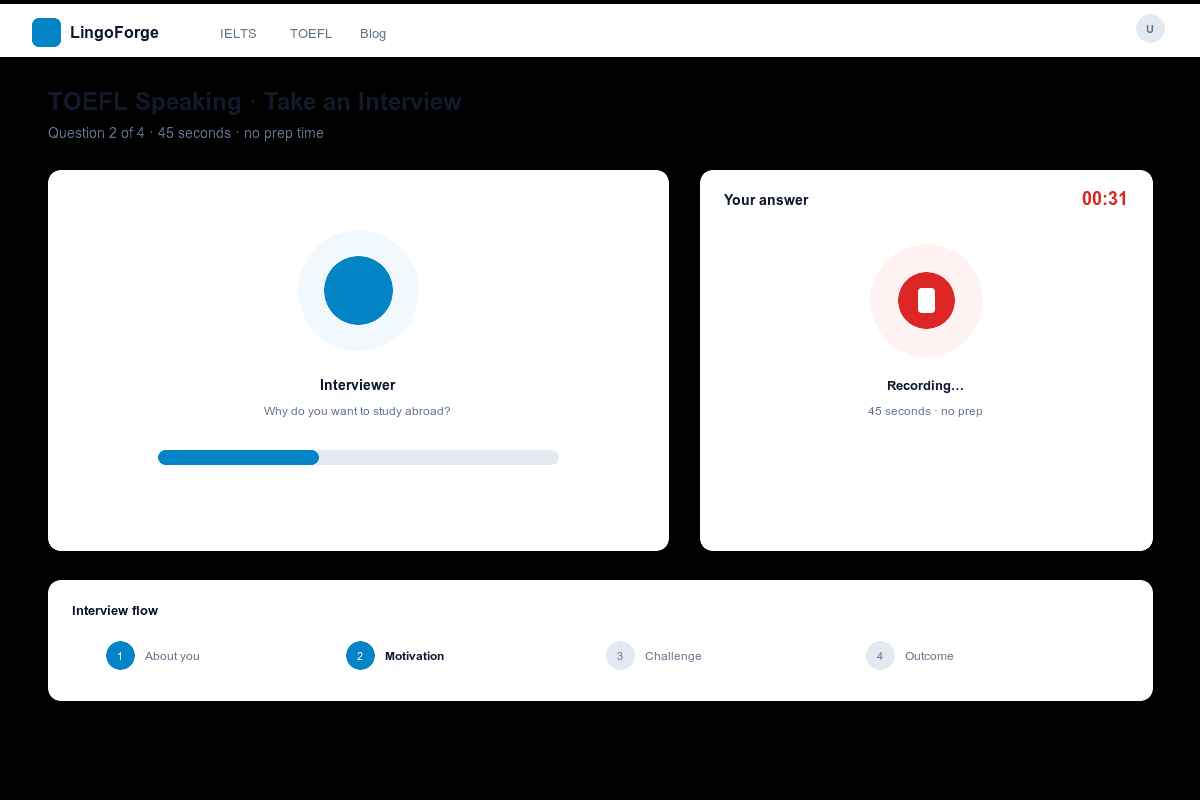
Record your answer
Speak within the same time limit as the real test — no pausing, no retakes on the first pass.
- Answer in the first sentence — no warmup
- Keep going after a stumble
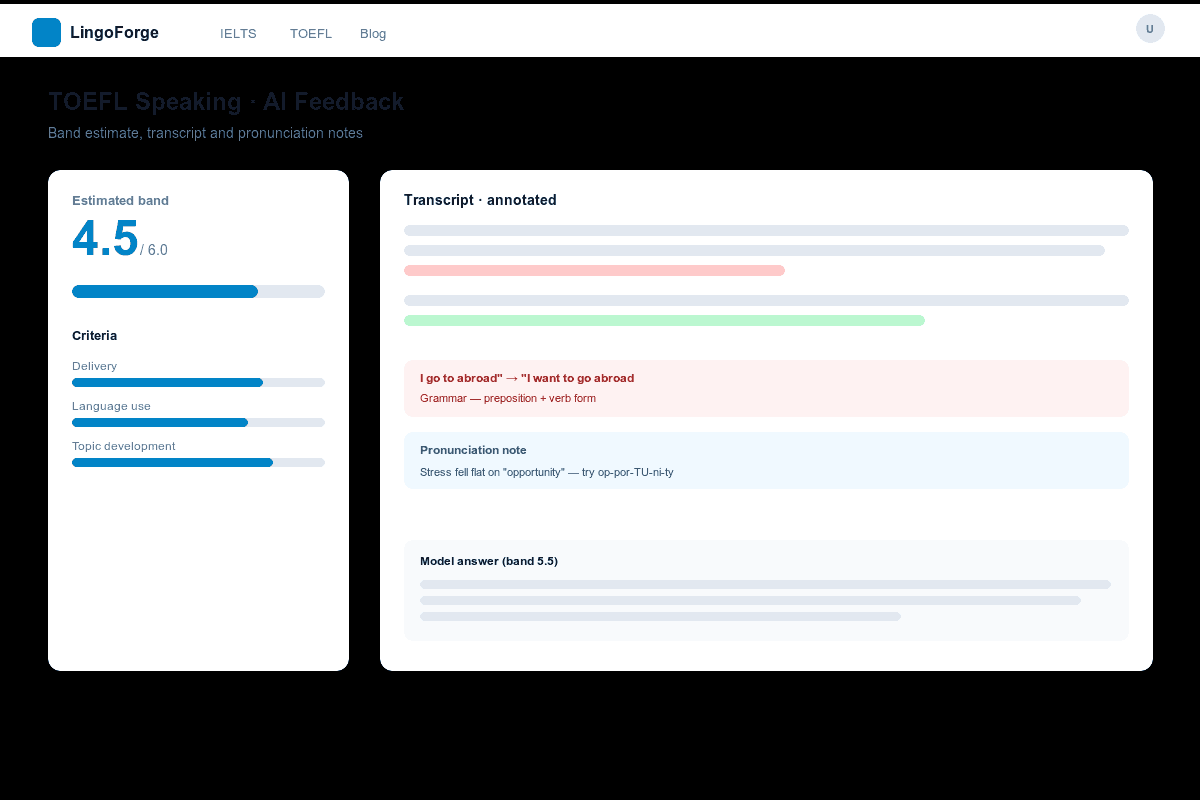
Review AI feedback
Get your band estimate, transcript, pronunciation notes, and a model answer.
- Re-record the same question applying the feedback
- Compare your structure to the model answer
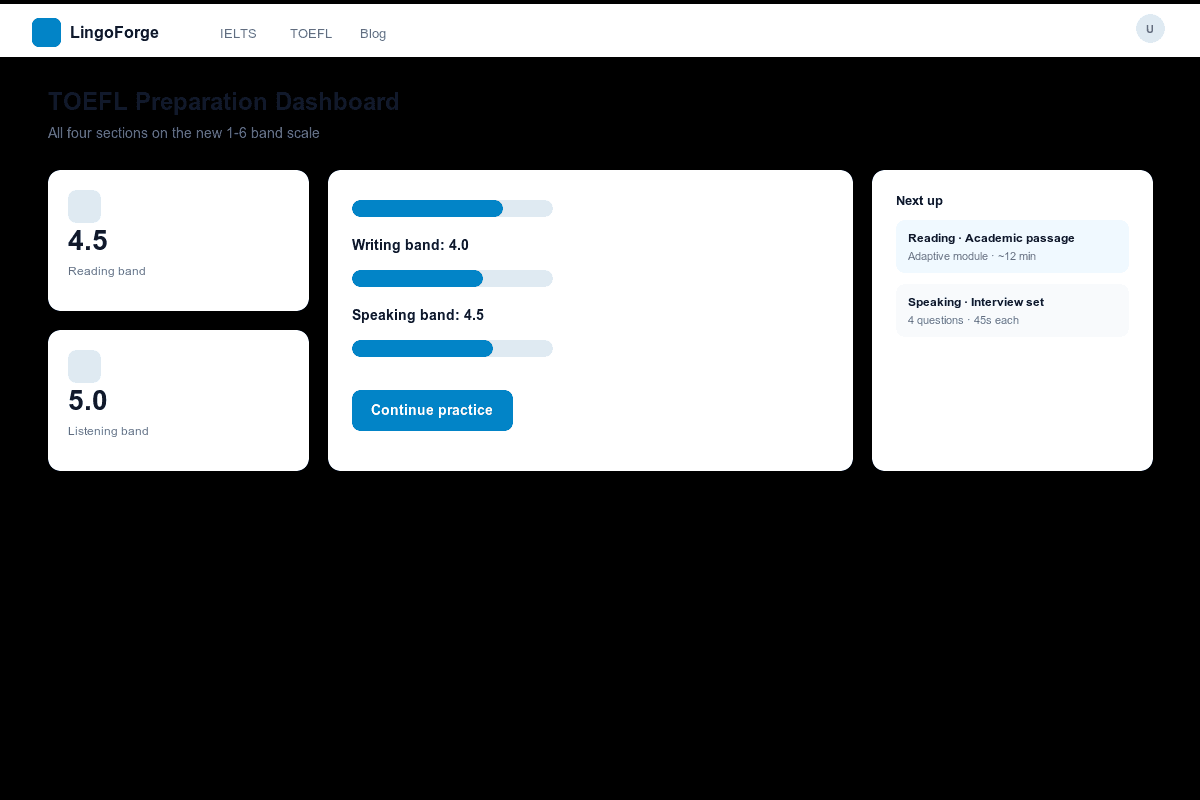
Official TOEFL sources
The exam-format facts on this page are checked against official ETS resources. Retrieved 2026-11-03.
Ready to practice TOEFL Speaking?
Record a response now and get instant AI feedback on the 1-6 band scale.
Practice TOEFL Speaking