
What is the TOEFL Reading section format in 2026?
TOEFL Reading is a multistage adaptive section of about 30 minutes with roughly 50 items. Module 1 is a router for everyone; Module 2 adapts to your ability. Tasks include Complete the Words, Read in Daily Life (emails, notices, posts), and Read an Academic Passage with comprehension questions. It is scored on the 1-6 band scale.
The three TOEFL Reading task types
Each module mixes shorter interactive tasks with longer passages. Know what each one demands before test day.
Complete the Words
A short text with missing letters or words. You complete the words from context — tests vocabulary in use and spelling under time pressure, not memorization.
Read in Daily Life
Short practical texts — emails, announcements, forum posts, schedules — followed by questions about purpose, detail, and inference. Rewards fast, accurate scanning.
Read an Academic Passage
A university-level passage (science, social science, humanities) with comprehension questions: main idea, detail, inference, vocabulary-in-context, and sentence insertion.
Reading strategies that work on an adaptive test
Win the router module
Module 1 decides your ceiling. Slow down slightly on the first module — a careless start routes you to the easier second module and caps your band.
Answer every item
There is no penalty for a wrong answer and you cannot return between stages, so commit to a best answer before moving on.
Match the task to the clock
Complete the Words and daily-life texts are quick wins — bank time there so academic passages get your full attention.
Read questions before the passage
For academic passages, skim the questions first so you know which details to hunt while reading.
Use context for vocabulary items
Vocabulary-in-context answers live in the surrounding sentence — reread the sentence plus the one before and after before choosing.
Pacing for a ~30 minute adaptive section
• Budget roughly two-thirds of your time for the academic passages — the shorter tasks should move quickly.
• Never leave blanks: since you cannot return to a stage, make your best guess and move forward.
• If a single question stalls you past 90 seconds, answer and flag it mentally — rhythm matters more than perfection.
• Practice with a visible timer until pacing is automatic; adaptive tests reward steady throughput.
• In practice, review why Module-1 misses happened — they cost the most band points.
How Reading is scored on the 1-6 band scale
Your raw points across both modules convert to a section band from 1 to 6 in half-point steps, aligned to CEFR levels. Score reports also show a comparable 0-120 total during the transition period.
Handles dense academic texts and implied meaning. Typical selective-university target.
Solid comprehension of academic and daily-life texts with occasional inference gaps. Meets many university minimums.
Understands main ideas and explicit details; struggles with dense syntax and low-frequency vocabulary.
Building-block comprehension. Focus on daily-life texts and core academic vocabulary first.
How to practice
Practice TOEFL Reading on LingoForge
Three steps from opening a passage to reviewing your mistakes.
Open a TOEFL Reading task
Choose a practice set from the Reading library — daily-life texts and academic passages in exam layout.
- Start with a short set if you are new to the format
- Use the same split layout as the real test

Answer under time
Work through the items with the timer visible, just like the adaptive module on test day.
- Commit to an answer before moving on — no going back
- Watch the clock, not the question count
Review explanations
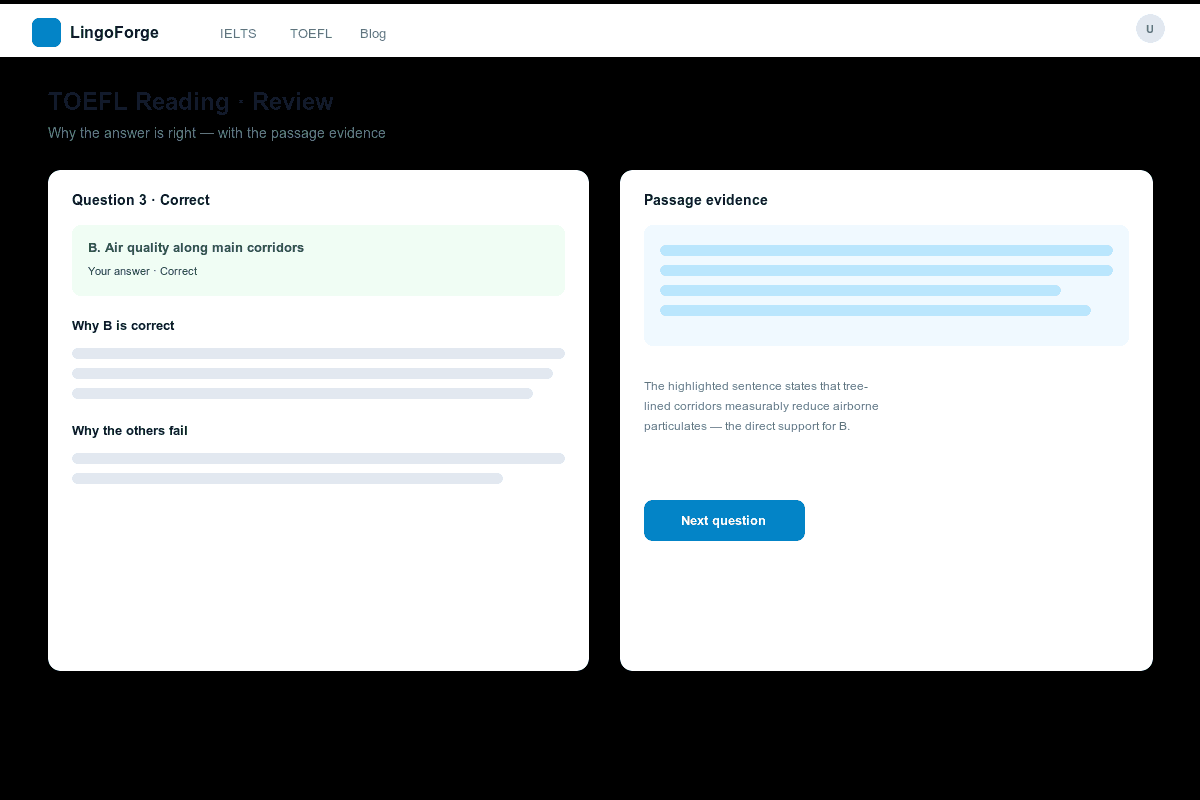
See which answers were right, why the wrong ones failed, and what evidence the passage gave.
- Read the explanation for every miss, not just the score
- Revisit the passage lines the question targeted
Official TOEFL sources
The exam-format facts on this page are checked against official ETS resources. Retrieved 2026-11-03.
Ready to practice TOEFL Reading?
Start a free Reading session and get instant feedback on every answer.
Practice TOEFL Reading