Set up a ForgeTutor course in minutes: pick a track, link an exam profile, run the intake, and let five diagnostic cards build a path. 91% reach target band.

More than 3.5 million IELTS tests are taken worldwide each year (IELTS.org, 2024), yet most candidates still revise without a ranked plan. A blank ForgeTutor course isn't a dead end — it's the starting point for a grounded study plan built from a track choice, an optional exam profile, a short intake, and diagnostic evidence.
The promise is narrow and practical. ForgeTutor course setup replaces generic study with a personalized knowledge-point path and one clear next action. You don't have to guess which module to open on Monday morning, because the dashboard names the next move for you.
This guide walks the full sequence. You'll create a course at /tutor, link an exam profile if it earns its keep, complete the intake, run up to five cold-start cards when no evidence exists, and launch your first course-bound tutor session. Ten minutes of setup shapes the next ten weeks of study.
ForgeTutor courses run on four tracks: General English, IELTS Academic, IELTS General, and TOEFL.
An exam-profile link is optional, but it sharpens targeting.
The intake builds a ranked knowledge-point path; up to five cold-start cards add evidence.
91% of LingoForge students reach their target band (LingoForge, 2026).
ForgeTutor course setup starts with one of four tracks, so the course is grounded before any study begins. 91% of LingoForge students reach their target band (LingoForge, 2026). A strong setup gets three things right: track choice, an optional exam-profile link, and a short intake that ranks your knowledge points.
Three anchors do the work: the track, the exam-profile link, and the intake. The track sets which curated knowledge base ForgeTutor draws from. The exam-profile link sharpens targeting toward a specific module and band. The intake decides which knowledge points come first.
A strong setup is also evidence-aware. If official attempts already exist, ForgeTutor's adaptive learning consumes them automatically. If you're brand new, the platform runs a bounded diagnostic of up to five cards instead of guessing from nothing.
[UNIQUE INSIGHT] Here's the gap most study tools leave open. A course that starts from a blank slate tends to recycle beginner material you've already mastered. ForgeTutor's setup stage exists to stop that repetition before it costs you a month.
Why does track choice carry so much weight? Because every generated card, explanation, and review item is drafted from the curated knowledge base attached to that track. Choose carelessly and your practice drifts away from the exam you'll actually sit.
Course setup decides how relevant every later practice card is. LingoForge reports a +1.0 average band improvement in about four weeks across 5,000+ trained students (LingoForge, 2026). That gain depends on a path built from evidence at the start, not a generic syllabus.
ForgeTutor offers four explicit tracks, so you choose by target exam or by general proficiency goal. TOEFL iBT scores are accepted by more than 11,500 institutions in over 160 countries (ETS, 2024). Pick the track your destination actually requires, not the one that sounds most ambitious.
IELTS Academic suits university admission and professional registration. IELTS General Training fits migration and work contexts. The Reading and Writing tasks differ between the two modules, so the knowledge points differ too. Both share Listening and Speaking, which keeps some practice common.
No exam date yet? Start with General English. It builds core grammar, vocabulary, and comprehension without locking you into a module. You can add an exam-profile link later without losing progress or rebuilding the course.
Does the module really change what you practise? It does. Academic Writing Task 1 asks you to describe charts, tables, and processes, while General Training asks for letters. TOEFL reading leans on academic passages, so TOEFL Reading strategies look different from IELTS skim-and-scan habits.
Before committing, check the requirement page of your target university, licensing body, or immigration authority. The British Council IELTS preparation hub lists free practice material by skill, and most institutions state which module they accept in plain terms.
If you're weighing hubs, the IELTS preparation platform covers both modules across Reading, Listening, Writing, and Speaking. Choose a track first, then let the knowledge-point path tell you which section needs the next hour.
Creating a course happens at /tutor, where you name the course, pick a track, and confirm setup. LingoForge students gain about +1.0 band in four weeks on average (LingoForge, 2026). That clock starts with a two-minute course creation, not a three-hour study marathon.
The flow is short and linear:
Sign in to your LingoForge account.
Open /tutor from the main navigation.
Click create course and give it a specific name.
Choose General English, IELTS Academic, IELTS General, or TOEFL.
Optionally link the course to your exam profile.
Save the course, then read the dashboard's next recommended action.
Three mistakes are common. Vague names like "English" make a dashboard hard to scan six weeks later. Skipping track selection leaves the knowledge base undefined. Expecting the platform to infer an exam goal without a profile link usually produces a looser, less targeted path.
What should you do immediately after saving? Read the next recommended action before touching anything else. If you want a wider frame around the course, pair it with this four-week mock test sprint so formal practice and daily mastery work in step.
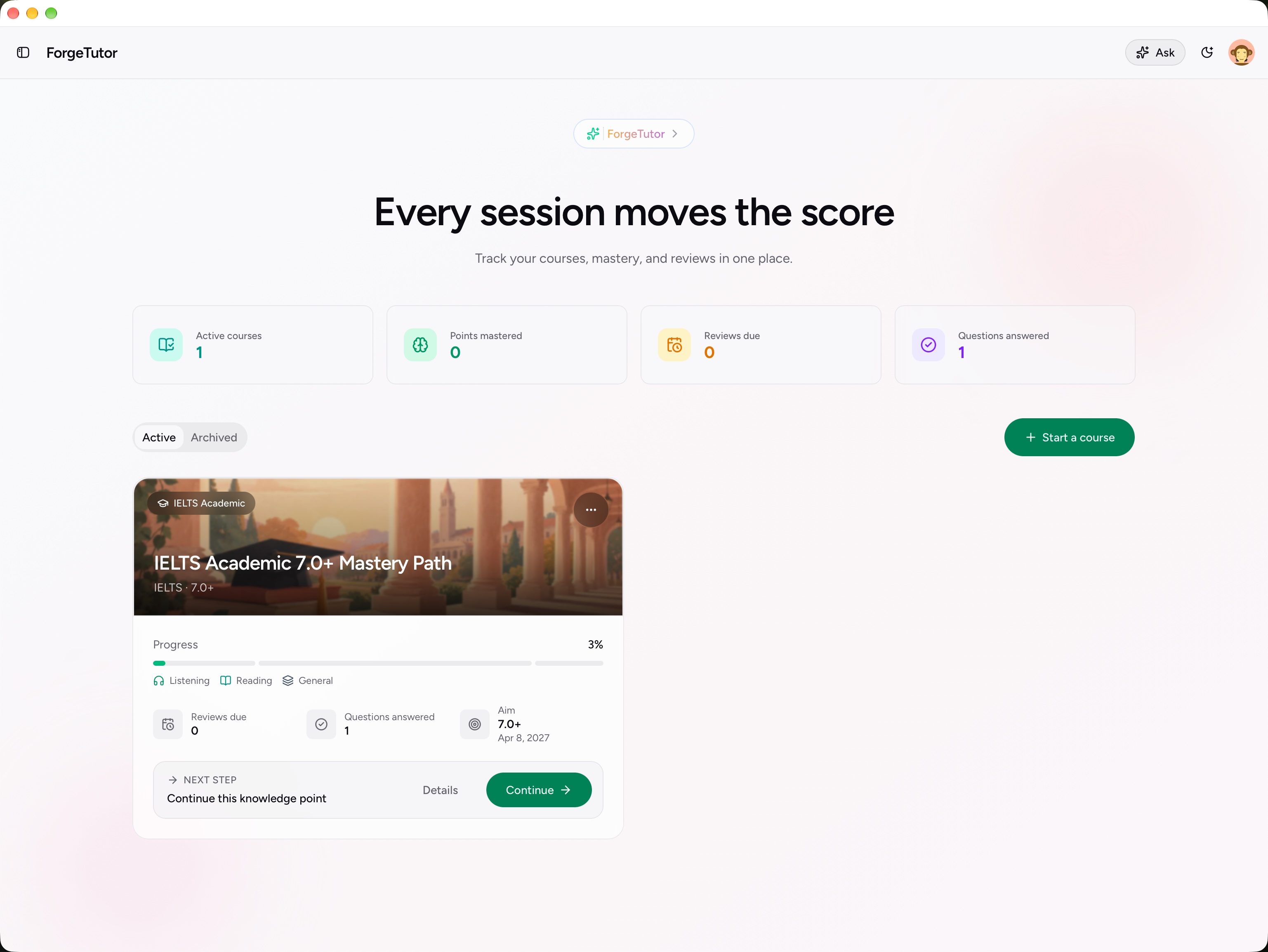
The course dashboard names one next action instead of a wall of modules.
Linking an exam profile is optional, but it sharpens targeting. IELTS results stay valid for two years (IELTS.org, 2024), so it's worth telling ForgeTutor which module and target band you're chasing. Skip the link if you're still exploring options.
Link the course when you have a fixed exam date, a known band target, or a registration deadline. Those facts let ForgeTutor weight knowledge points toward the sections that decide your score, instead of spreading effort evenly across all four.
Skip it when you're exploring options or building general proficiency. A General English course with no exam profile still produces a ranked path, and nothing is greyed out. It simply follows proficiency goals rather than module-specific ones.
Switching is painless. Update the exam profile and the path re-ranks; you don't rebuild the course. [PERSONAL EXPERIENCE] Learners who know their test week rarely stall on the intake, because a fixed deadline answers the priority questions for them.
Does a profile link change the practice cards themselves? It changes emphasis, not format. Official activities stay on their own routes too: full IELTS mock tests still feed evidence back into your course after every attempt. Timing matters as well, and scheduling your last mock three days before exam day is a sensible rule.
The short intake is the personalization engine. Answers turn a blank course into a ranked knowledge-point path rather than a generic syllabus. 91% of LingoForge students reach their target band (LingoForge, 2026), and that targeting starts with what you report during intake.
Expect questions about goals, confidence per section, recent practice, weak areas, and weekly time available. Each answer maps to specific knowledge points. Low confidence in Listening pulls listening items higher in the queue; a tight schedule trims the number of active modules.
Here's a concrete mapping. Flag grammar as a weak area and the path surfaces tense and sentence-structure points first, with ten grammar rules for IELTS Writing Task 2 becoming live practice material rather than background reading. Vocabulary gaps route to typing and dictation drills, the approach compared in typing versus flashcards for vocabulary retention.
Read the resulting path top-down, not sideways. Start with the dashboard's next recommended action instead of browsing modules that merely look interesting. Then revisit the ranking after every official attempt, because fresh evidence reshuffles priorities faster than intuition does.
Where does ForgeAI fit? Ask ForgeAI opens an in-context chat pre-loaded with the prompt, a sample answer, and your own draft. It's the companion inside a single practice attempt; ForgeTutor runs the longer mastery loop across sessions.
The intake is where a course stops being generic. LingoForge's 91% target-band rate across 5,000+ trained students (LingoForge, 2026) depends on ranked knowledge points, and that ranking depends on honest intake answers about weak sections and available study hours. Get those answers roughly right and the path does the rest.
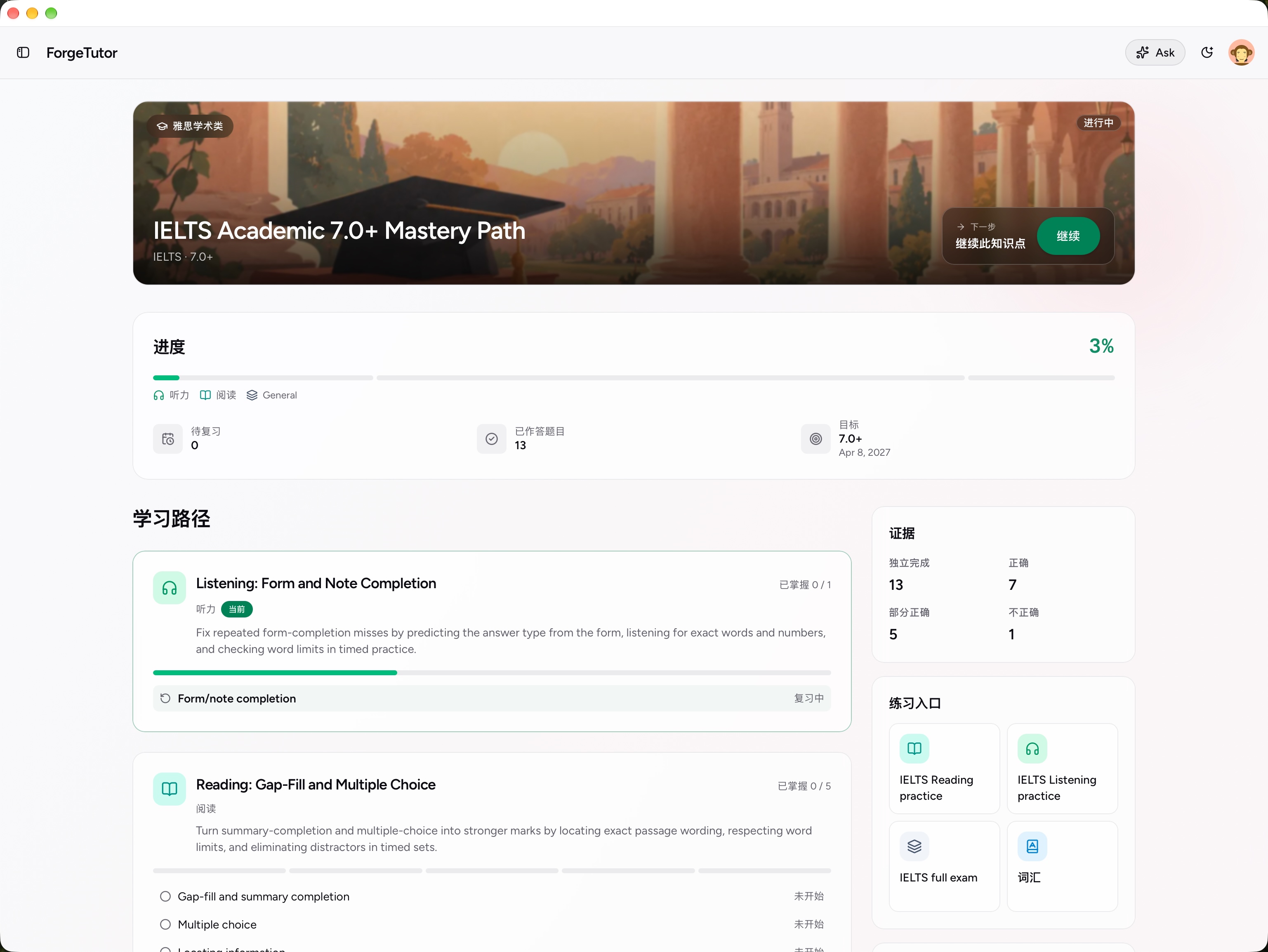
Intake answers rank knowledge points, so the first card is never arbitrary.
If no evidence exists yet, ForgeTutor runs a bounded cold-start diagnostic of up to five cards. Dunlosky and colleagues rated practice testing and distributed practice as the only high-utility techniques among ten reviewed (Psychological Science in the Public Interest, 2013). Five cards deliver that signal without a placement marathon.
The cap matters. It keeps onboarding short, reduces fatigue, and prevents over-testing before you've genuinely started. You answer a handful of items, get instant grading, and move into real practice with a hypothesis instead of a blank slate.
Cards arrive as multiple choice, multi-select, short answer, and True/False/Not Given items generated from the curated knowledge base. Each one is graded immediately with an explanation and error diagnosis, so even a wrong answer teaches something concrete.
Results feed straight into the path. A missed item on inference or referencing pushes reading-focused knowledge points toward the top. The dashboard then sets your first recommended action from those outcomes rather than from a default template.
Isn't five cards too few to judge a level? It's deliberately few. The diagnostic seeds a hypothesis, not a verdict, and that hypothesis sharpens with every later attempt. To see how quickly the loop can move, read how one student improved from Band 6 to Band 7 with AI feedback.
A short diagnostic beats a long placement test. ForgeTutor caps cold-start evidence at five cards, then relies on practice testing — one of only two high-utility techniques among ten reviewed by Dunlosky et al. (2013) — to keep refining the path.
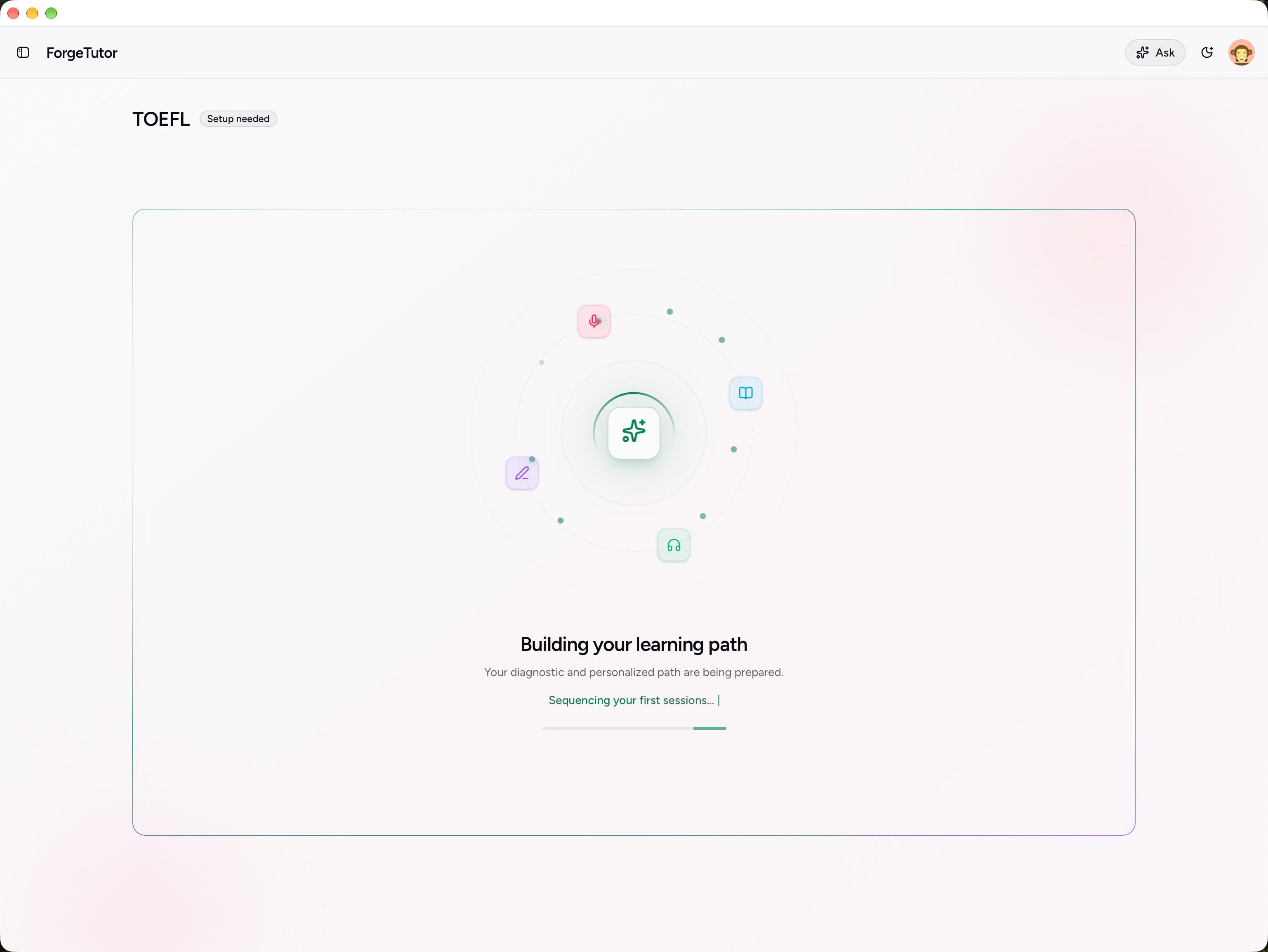
Five cards are enough to seed a path, then practice testing takes over.
The dashboard's next recommended action and the Study with ForgeTutor button launch a course-bound session, so session one already follows your path. LingoForge students average +1.0 band in about four weeks (LingoForge, 2026) by repeating this loop, not by browsing menus.
The launch sequence is four clicks wide:
Open the course dashboard at /tutor.
Read the next recommended action.
Click Study with ForgeTutor.
Confirm the session is bound to this course, then start the first card.
Expect the session to use your knowledge-point path and diagnostic evidence. A Feynman teach-back may appear when a concept needs a deeper check: explain the idea in your own words, and the tutor verifies whether the explanation actually holds together.
When you finish, return to the dashboard. The next recommended action updates, due spaced reviews appear, and error summaries accumulate. That visible change is the whole point of course binding, and it's why you shouldn't skip the return trip.
Official exam practice stays on its own routes. If speaking is your weak point, the feedback described in practising IELTS Speaking with an AI examiner complements the mastery loop nicely, and IELTS Speaking practice keeps transcripts and rubric feedback in one place.
Course-bound sessions work because the first card is already chosen. ForgeTutor ties every session to a knowledge-point path and diagnostic evidence, and LingoForge students following that loop average a +1.0 band gain in roughly four weeks (LingoForge, 2026).
Most setup questions come down to three things: track choice, evidence, and timing. LingoForge students average a 7.0+ band, and 91% reach their target (LingoForge, 2026). The answers below cover the rest of what new learners ask before their first session.
No. The exam profile is optional. ForgeTutor still builds a path from your intake answers and up to five cold-start cards. Link IELTS Academic, IELTS General, TOEFL, or a general goal only when it sharpens targeting. 91% of LingoForge students reach their target band (LingoForge, 2026), whether they start narrow or broad.
Use the bounded cold-start diagnostic. It caps at five cards, so you answer a short set before your first tutor session. Those cards seed your knowledge-point path and the dashboard's first recommended action. Practice testing earned a high-utility rating from Dunlosky et al. (2013), so a brief test is time well spent.
Yes. Start with General English if you're unsure, then add IELTS Academic, IELTS General, or TOEFL targeting later. Results stay valid for two years (IELTS.org, 2024), so an early module switch costs little. ForgeTutor keeps the course usable and re-ranks the path instead of forcing a rebuild.
Open the dashboard and follow the next recommended action, then click Study with ForgeTutor. That launches a course-bound session tied to your knowledge-point path, so the first card starts from evidence rather than a blank page. Students repeating this loop average +1.0 band in about four weeks (LingoForge, 2026).
ForgeTutor course setup is finished only when the dashboard points to a next action. 5,000+ students have trained on LingoForge, and 91% reach their target band (LingoForge, 2026). The goal was never a filled-in form; it's a course-bound session you can start today.
Recap the sequence: choose a track at /tutor, optionally link an exam profile, complete the intake, run up to five cold-start cards if evidence is missing, then click Study with ForgeTutor. Each step takes minutes and compounds over weeks.
Then build the habit. Return to the dashboard after every session, follow the next recommended action, and let new evidence update the knowledge-point path. If you want broader framing alongside the loop, these IELTS study tips for Band 7 and above pair well, and you can start a free LingoForge trial to test the loop for yourself.
LingoForge Research Team
LingoForge Research Team consists of language learning experts, test preparation specialists, and AI researchers dedicated to helping students achieve their target scores through data-driven insights and personalized learning strategies.

Compare LingoForge, Langium, IELTS Ace, TestGlider, and British Council IELTS Ready on AI feedback, tutoring, practice, pricing, and who each may suit.

Master collocations for IELTS Writing Band 8. Over 90% of Band 8 essays use 15+ collocations per 250 words. Learn how with LingoForge's real-time feedback.