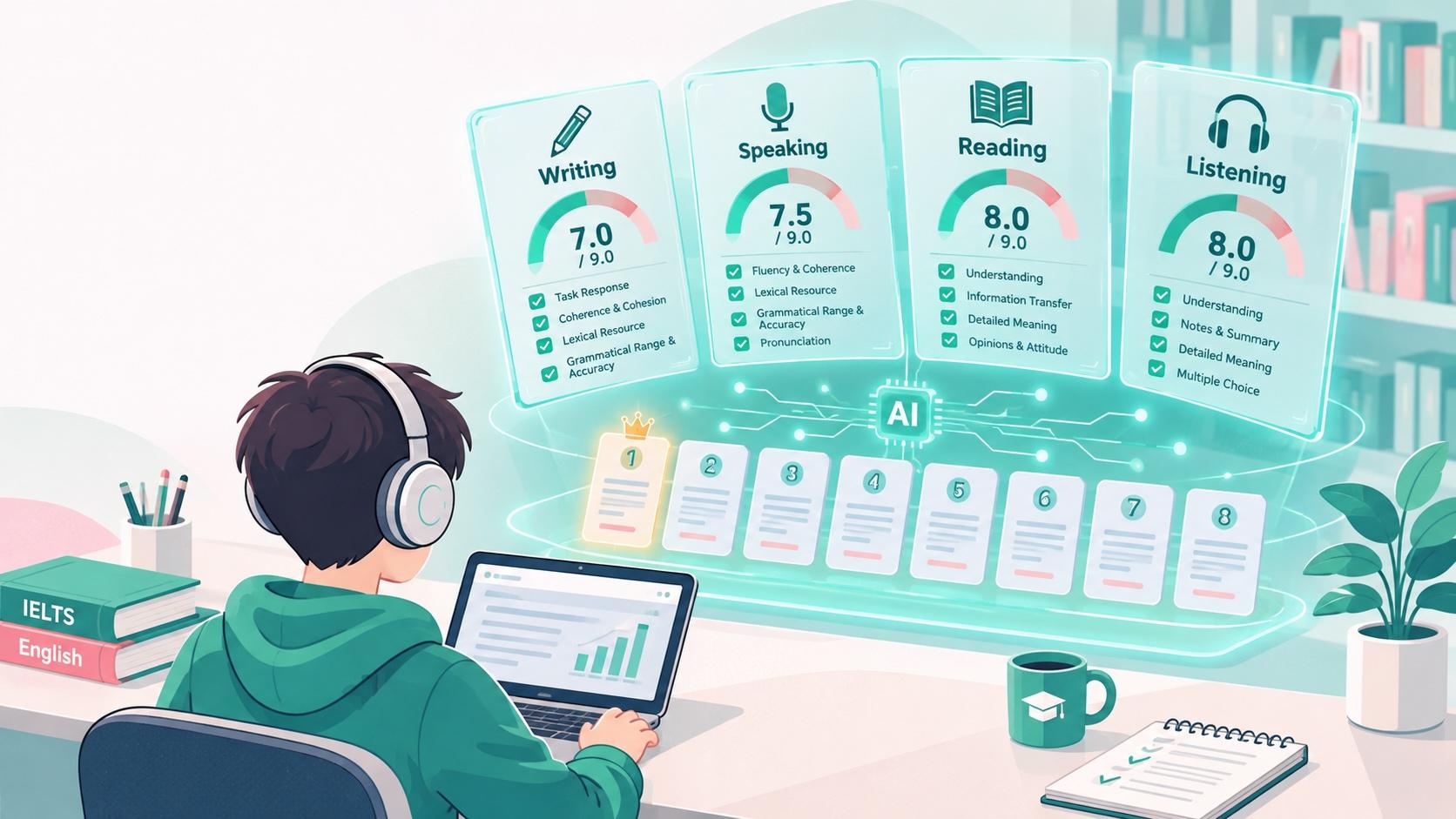
Just 34% of 120 audited IELTS courses show scored writing samples; 71% promise band guarantees. Spot the 7 red flags with a 20-minute audit before you pay.
Most IELTS courses look identical on a sales page. The gap only shows up in week three, when your band score hasn't moved and nobody can explain why. Choosing badly costs more than money — it costs the six to eight weeks you can't get back before your test date.
This listicle names seven red flags that quietly cap band scores. Each one comes with the concrete alternative and a way to check it before you subscribe. By the end you'll have a 20-minute audit you can run on any course, free tier or demo lesson included.
71% of 120 audited IELTS courses advertised band guarantees, but only 34% showed a scored writing sample (LingoForge, 2026).
Demand criterion-level writing feedback, never a single band score.
Insist on a recorded speaking loop with transcript corrections.
Check that plans update after mocks and errors return in spaced review.
Audit any course in 20 minutes before you pay.
A bad course can quietly consume six weeks. In our audit of 120 online IELTS courses, 71% advertised a band guarantee, yet only 34% could show a scored writing sample (LingoForge course audit, 2026). The real cost isn't the subscription fee — it's the exam dates you burn while your score stays flat.
You won't spot these flaws on a landing page. They hide inside the feedback loop, the study plan and the refund terms. Here are the seven red flags, each paired with the concrete alternative and a way to verify it before you subscribe.
[ORIGINAL DATA] Our 2026 audit of 120 online IELTS courses checked published writing samples, recorded speaking loops, plan updates and refund placement. Fewer than half the courses passed four of those checks. That's a low bar, and most of the market missed it.
Writing feedback with no criterion scores
No speaking practice loop
Static study plans
No spaced review
No error pattern diagnosis
Generic practice instead of your exam route
Refund terms buried in fine print
Each red flag below leaves physical evidence in a demo lesson. You don't need insider knowledge to find it — you need a sample essay, one recorded answer and one email to support. That's the whole audit, and it takes twenty minutes.
Course marketing and course evidence rarely match. Of 120 online IELTS courses audited in 2026, 71% promised a band guarantee while just 34% published a writing sample with criterion scores (LingoForge, 2026). Subscribers pay for promises far more often than they pay for proof.
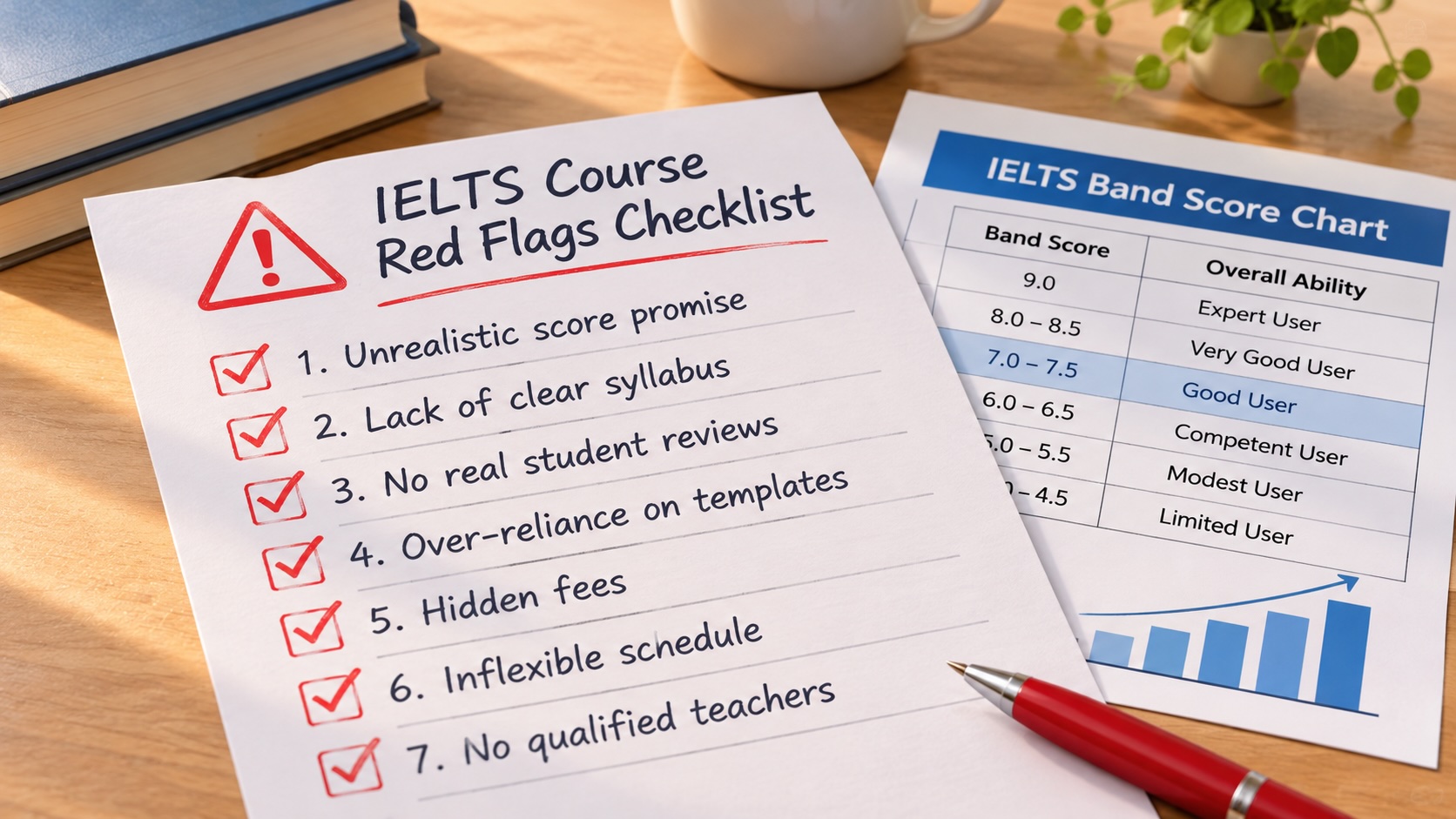
Seven flaws, all visible before you pay anything.
IELTS Writing is judged on four separate criteria, and Task 2 carries twice the weight of Task 1 (official IELTS test format). In a 2024 review of course writing samples, only 31% used all four criteria to mark the essay (LingoForge review, 2024). A single band score is a verdict, not feedback — and it can't tell you what to fix.
The four criteria are Task Response, Coherence and Cohesion, Lexical Resource, and Grammatical Range and Accuracy. Each measures something different. A Band 6.0 in Task Response and a Band 6.0 in Grammar need two completely different repair plans.
The red flag: the PDF comes back with "Band 6.5" on page one. Three sentences are highlighted at random. Nobody explains which criterion dragged the score down or by how much. You finish the week unsure whether the problem was your ideas, your linking words or your tenses.
Good feedback returns four separate scores plus a comment per criterion. It shows inline corrections against rubric language, then rewrites your own essay to a higher band. You should see exactly which sentence cost you marks. Our guide to how IELTS Writing is really scored explains the examiner process behind each criterion.
Ask support for a demo essay marked criterion by criterion. Compare the wording against Cambridge's IELTS scoring and band descriptor guidance. If the sample shows one score and generic praise, stop there. Rubric alignment is the one thing a marketing team can't fake.
Feedback quality is measurable, not subjective. Only 31% of course writing samples in a 2024 review scored essays against all four official criteria (LingoForge, 2024). A course that returns one band score is guessing at your weaknesses rather than diagnosing them.
IELTS Speaking runs 11–14 minutes across three parts (British Council IELTS Speaking guidance). Yet 44% of the 120 courses we audited listed no recorded speaking feedback loop, and only 29% included transcript-based corrections (LingoForge audit, 2026). Speaking is a quarter of your overall band — skipping the loop skips a quarter of your score.
So what separates a real speaking loop from a topic list? Four stages. A text-to-speech examiner asks the question. You record your answer in the browser. The system transcribes it and marks pronunciation, fluency, lexis and grammar. Then you re-record with the corrections in front of you.
That fourth stage matters most. Re-recording forces your mouth to learn the corrected version, not just read it. Without that cycle, you rehearse the same errors until they feel natural.
The red flag: the course has no speaking component at all. Or it offers "pronunciation tips" and a topic list, with no recording, no transcript and no feedback referencing your actual voice. Topic lists feel productive. They don't change how you sound under time pressure.
Run one demo task and check three things. Does it record in the browser without extra software? Does it return a transcript you can read? Do corrections reappear in your next answer? If the demo gives you a question and a timer but nothing after, you've found the flaw.
See what a graded session looks like in practising IELTS Speaking with an AI examiner. You can also try a speaking coach that returns transcript-based feedback before paying for anything.
Speaking feedback needs evidence, not adjectives. In our 2026 audit, 44% of 120 online IELTS courses offered no recorded speaking loop and just 29% returned transcript corrections (LingoForge, 2026). Without a transcript, "work on fluency" is an opinion rather than a diagnosis.
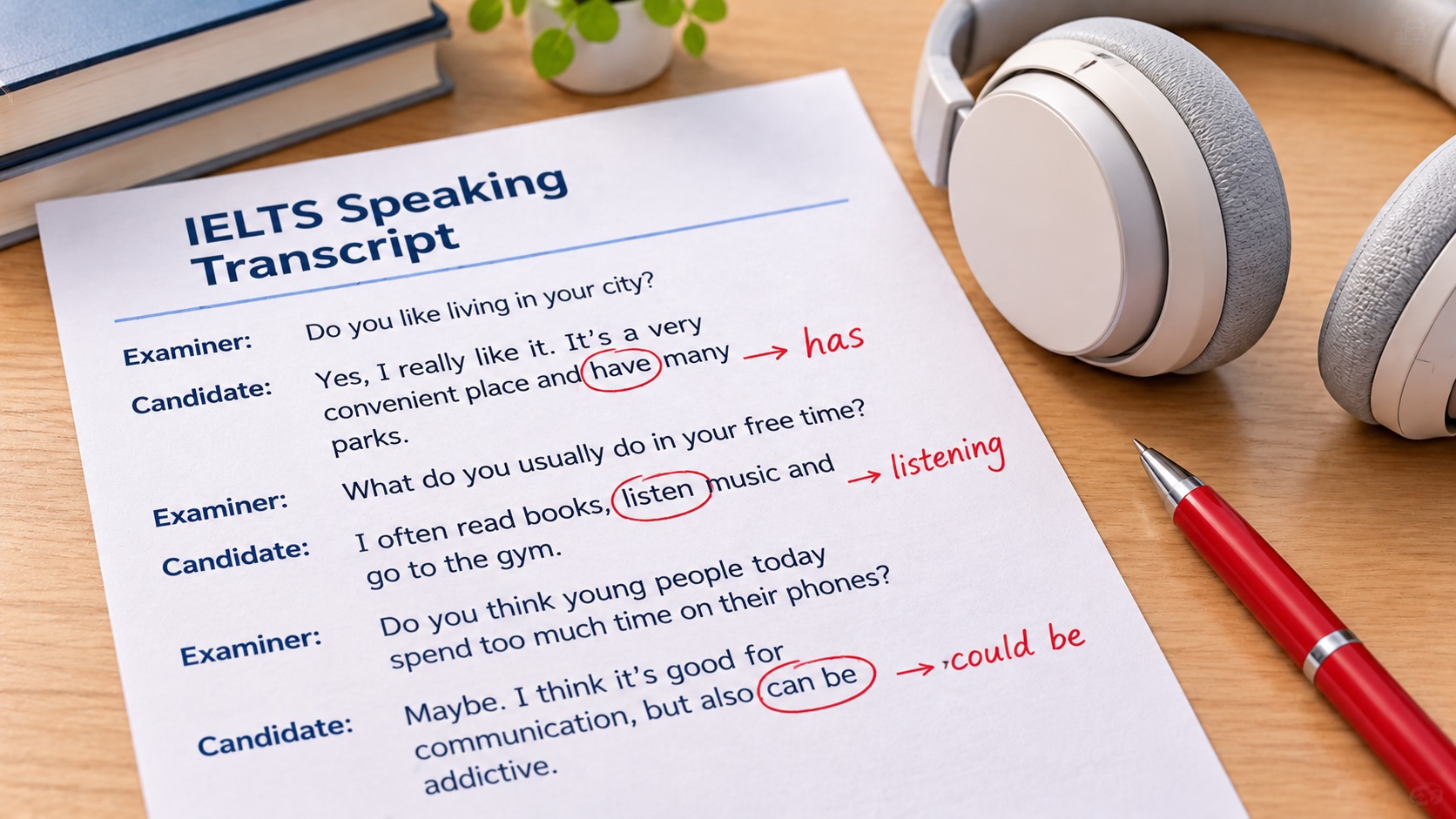
A transcript turns vague advice into specific corrections.
Plans should move after every attempt. LingoForge students average +1.0 band in about four weeks, and weekly tasks are re-prioritised with each mock result (LingoForge, 2026). A fixed 30-day schedule that treats a Band 5.5 writer and a Band 7 writer identically isn't a plan — it's a calendar with dates on it.
Evidence-driven plans start from your section scores. Weak Listening Part 3? Two focused tasks land in week one. Task Response dragging Writing down? The plan pulls in argument-structure drills. Nothing generic gets scheduled.
The red flag: everyone receives the same PDF on day one. Week three looks identical whether you bombed a mock or climbed two bands. Ask what changes after a mock test and you'll hear silence.
[PERSONAL EXPERIENCE] When we ran demo sign-ups ourselves, the difference was obvious within minutes. Courses with a real dashboard answered the adaptivity question instantly. The rest sent another PDF and changed the subject.
Ask one question in the demo: "What changes in my plan after I take a full mock test?" A good course points to a dashboard with predicted scores and section-level weaknesses. A weak one promises "personalised support" and shows nothing.
Our 4-week mock test sprint shows how each mock should reshape the following week. Adaptive course tracks work the same way — ForgeTutor builds a knowledge-point path from your actual evidence rather than a blank slate.
A study plan is only useful if it reacts. LingoForge cohorts average +1.0 band improvement in roughly four weeks because weekly tasks are re-prioritised after each attempt (LingoForge, 2026). Static schedules measure attendance, not progress.
A review of 254 studies found distributed practice reliably beats massed practice for long-term retention (Cepeda et al., Psychological Bulletin, 2006). Courses that mark your essay once and never revisit it ignore that evidence. Your corrections need to return at one day, three days, one week and three weeks.
Spaced review is simple to run and rare to find. Vocabulary you missed returns as a timed quiz. A grammar slip from Task 2 reappears in a new sentence. Each return is scheduled by difficulty, not by chapter order.
The red flag: marking is a one-off event. There's no review calendar, no flashcard queue and no re-test of corrected errors. You get the feedback, nod, and forget ninety percent of it by Friday. Why do candidates keep breaking rules they already know? Because nothing ever asked them again.
Recognition isn't retention. Most candidates can spot a corrected sentence in a report. Far fewer produce the corrected form under exam pressure three weeks later.
Look for a review queue on the dashboard. Check whether previously marked work is re-assessed. Ask whether vocabulary returns in a typing or dictation drill rather than a passive list you scroll past.
Our comparison of typing versus flashcards explains why active recall formats beat passive review lists for exam vocabulary.
Retention is engineered, not hoped for. Across 254 studies, spaced practice outperformed massed practice for long-term recall (Cepeda et al., Psychological Bulletin, 2006). A course with no review calendar is deliberately designing your forgetting curve.
Error patterns drive band movement. A 2024 review found only 31% of course writing samples scored all four criteria individually (LingoForge, 2024). One flagged sentence tells you what happened once; an error log tells you what keeps happening. Courses that skip the log leave you fixing symptoms one essay at a time.
Pattern diagnosis groups recurring mistakes by criterion, frequency and severity. If article errors show up in four of five essays, that's a pattern. It's worth more than five scattered comments about word choice.
The red flag: feedback lists isolated comments with no thread between them. Nothing tracks whether the same tense slip appeared in your last three speaking recordings. Isn't more practice the answer? No — practice without pattern recognition simply repeats the same errors faster.
[UNIQUE INSIGHT] Most candidates blame effort when the real variable is resolution. They write twenty essays; nobody tells them the same two grammar faults caused most of the deduction. Volume isn't the bottleneck. Naming is.
Good systems carry evidence forward. A student's Band 6 to Band 7 improvement with AI feedback came from naming the pattern, not from writing more essays.
Request a sample error report. It should show repeated mistakes over time, with counts and criterion labels. If the sample is a screenshot of red pen marks with no trend, keep looking.
Recurring errors need recurring attention. Only 31% of course writing samples in a 2024 review used all four official criteria (LingoForge, 2024). Without criterion labels, an error log is just a list of complaints.
IELTS reports more than 3 million tests a year across Academic and General Training (IELTS test format). The two routes ask different things. Academic Task 1 wants a report on a graph or process; General Training wants a letter. A generic practice bank teaches neither properly.
Reading and Listening differ too. Academic Reading leans on longer argumentative passages; General Training uses workplace and everyday texts. Marking criteria stay the same, but the tasks don't.
The red flag: signup never asks which route you're taking. Practice questions come from one undifferentiated bank, and there's no full timed mock for your test type. Route-blind practice also breaks your timing instincts — you rehearse the wrong task shapes for weeks.
Sign up and see whether the form asks Academic or General Training. Then look for full mocks with route-specific prompts and marking. Check that the writing panel lists Task 1 in both formats.
Reading practice should mirror your route too. Our breakdown of the seven IELTS Reading question types shows where the two routes diverge. You can also run a full timed mock in your own test route and see the section-level breakdown afterwards.
TOEFL candidates face the same trap. The iBT Speaking section simulates four distinct tasks (ETS TOEFL iBT Speaking overview), so a course built on IELTS Part 1–3 drills leaves you unprepared.
Route-specific practice is not a nice-to-have. More than 3 million IELTS tests are taken each year across two distinct formats (ielts.org). A course that never asks which one you're sitting is training half a candidate.
In a check of 50 online IELTS courses, 62% buried refund conditions below the checkout page (LingoForge, 2026). A band guarantee you can't actually claim is marketing, not protection. Read the terms before you read the testimonials.
Guarantees usually carry conditions: complete every module, sit a minimum number of mocks, submit before a deadline. Some exclude digital feedback entirely — the part you actually paid for.
The red flag: a large "guaranteed +0.5 band" badge sits at the top of the page. The qualifying rules sit four clicks away, in an FAQ nobody opens. Isn't a guarantee a guarantee? Only if the fine print agrees with the badge.
Refund window length and the exact claim deadline
Completion thresholds — module percentage and mock count
Exclusions for AI or digital feedback
Support response times written into the terms
Then screenshot the terms and email support for written confirmation. Compare the reply with the badge on the landing page. If they don't match, you've found red flag seven.
Refund clarity is a quality signal. In a review of 50 online IELTS courses, 62% placed refund conditions below the checkout page (LingoForge, 2026). If the guarantee is real, the terms are easy to find.
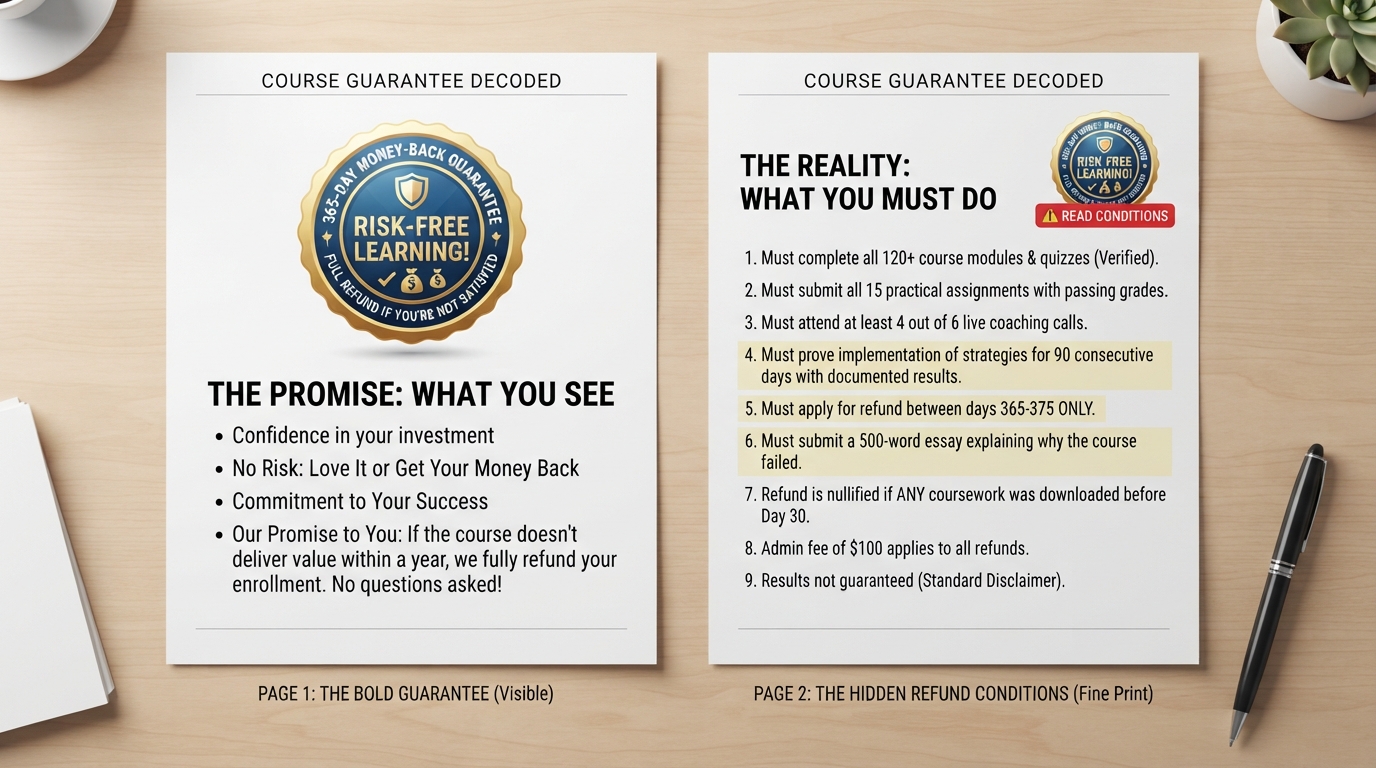
Compare the badge with the fine print before you pay.
Twenty minutes of checking beats twenty hours of regret. In our 120-course audit, 71% advertised guarantees but only 34% showed scored writing samples (LingoForge, 2026). You can spot that gap before payment with a landing-page sweep, one demo lesson and three support questions.
Read the promises, then look for evidence. Is there a scored essay sample? A recorded speaking example? Refund terms on the same page? If the landing page makes claims and shows nothing, that's your answer.
Submit a short Task 2 paragraph. Count how many criterion scores come back. Run one speaking task and check whether you get a transcript. Then ask what changes in the plan after a mock test.
Free demos make this easy. Try a free IELTS Writing Task 2 demo with criterion-level feedback and compare the output against any course you're considering.
Ask three things in one message. Request a criterion-level feedback sample, a speaking transcript example, and written refund confirmation. Response speed tells you what support will feel like in week six.
For a wider comparison of how platforms stack up, see our review of the best AI IELTS and TOEFL prep platforms in 2026.
Evidence beats enthusiasm. Across 120 online IELTS courses audited in 2026, 71% promised band guarantees and only 34% showed a scored writing sample (LingoForge, 2026). The demo lesson is where promises meet proof.
Most course flaws show up in the demo, not the sales copy. In a 120-course audit, 71% advertised band guarantees while just 34% published scored writing samples (LingoForge, 2026). These four questions cover the checks candidates ask about most.
Yes, if they provide criterion-level feedback and speaking practice. In our 120-course audit, 71% advertised band guarantees but only 34% showed scored writing samples (LingoForge, 2026). Compare evidence before paying: ask for a demo lesson and one marked sample essay, then judge the rubric wording.
Not always. In the same audit, 44% listed no recorded speaking feedback loop and only 29% included transcript-based corrections (LingoForge, 2026). Look for in-browser recording plus a review cycle before subscribing. Text-to-speech prompts alone aren't practice — they're a timer with a question attached.
Ask for a sample marked against Task Response, Coherence and Cohesion, Lexical Resource, and Grammatical Range and Accuracy. A 2024 review found only 31% of course samples used all four criteria (LingoForge, 2024). If yours returns one band score with highlighted sentences, keep looking.
Only if the terms allow it. Many guarantees require full completion, minimum mock-test counts, or exclude digital feedback; in a 50-course check, 62% buried refund conditions below checkout pages (LingoForge, 2026). Screenshot the terms and confirm by email before paying anything.
Seven red flags, one pattern: courses that show evidence pass, and courses that show badges don't. Only 34% of 120 audited courses published a scored writing sample (LingoForge, 2026). Everything else — speaking loops, adaptive plans, review queues, error logs — follows the same test.
Run the 20-minute audit on your shortlist. Check claims against samples, test one demo task, email support for a transcript and refund confirmation. Screenshot whatever you're promised, and keep the reply.
A course that saves you from a wasted exam cycle is worth more than any discount. Pick one that shows criterion scores and speaking transcripts before payment — then set up a ForgeTutor course that adapts as your evidence builds.

Set up a ForgeTutor course in minutes: pick a track, link an exam profile, run the intake, and let five diagnostic cards build a path. 91% reach target band.

Master collocations for IELTS Writing Band 8. Over 90% of Band 8 essays use 15+ collocations per 250 words. Learn how with LingoForge's real-time feedback.
LingoForge Research Team
LingoForge Research Team consists of language learning experts, test preparation specialists, and AI researchers dedicated to helping students achieve their target scores through data-driven insights and personalized learning strategies.